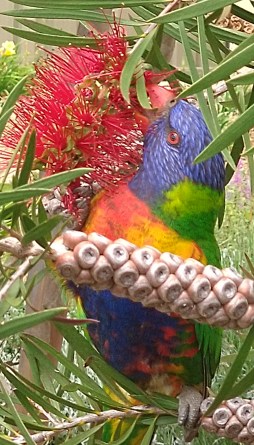
 Callistemon spp., Rince-bouteille, Zylinderputzer, Cepillo, Scuab bhuidéal
On the way to the station I noticed a whole bundle of dry bottlebrush stamens that had gathered in the gutter after a windy day or two. On the way back that very afternoon I scooped them up and trotted off home with the intention of seeing how wool would take any colour they had to offer.
Experience, let alone all the sources available, has taught me that red won’t yield red, and if it does, it’ll soon fade. In Dyemaking with Australian Flora, results are given for the leaves and fruits of various species, but not the flowers. However, after simmering the plant material, straining then adding the yarn, it was clear that some result would be obtained. I persevered…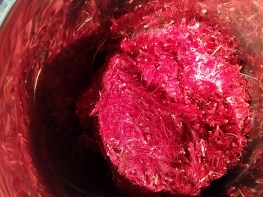
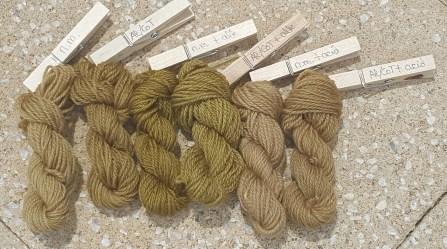
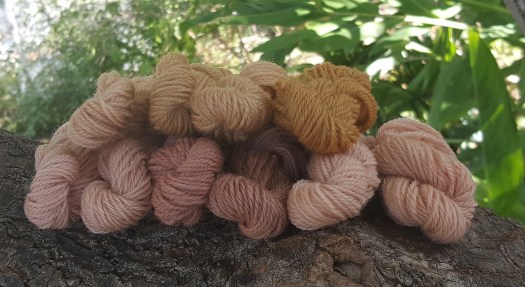
The final results were worthwhile, giving shades of brown and gold. Only problem was, I couldn’t remember which order I’d hurriedly stashed them (mordanted/non-mordanted) to do other things before writing this entry… Drawing on experience, the alu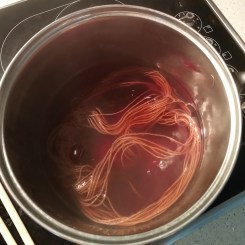 m/CoT mordant gave yellower shades, the alkaline modfier deepended these, the acid modifier didn’t make much difference, although I think (or perhaps am imagining) a slightly redder shade, whilst the iron modifier clearly deepened the shades as expected without “blackening”. There’s also none of the potentially resulting harshness.
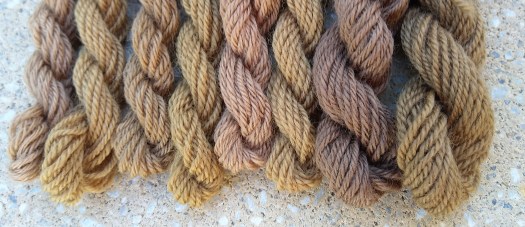
From left to right: 1, 3, 5, 7 no mordant; 2, 4, 6, 8 alum/CoT, 3 + 4 alk modifier, 5 + 6 acid modifier, 7 + 8 iron modifier. The colours in real life are deeper.
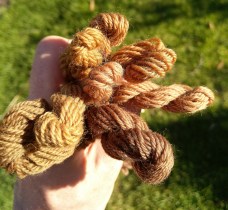
Would I dye with bottlebrush again? Sure, if enough material could be found again. Callistemons are used as street trees in a lot of suburbs, so they’re not exactly rare or endangered. However, usually the stamens just blow off individually and don’t amass, so looks like I was lucky.
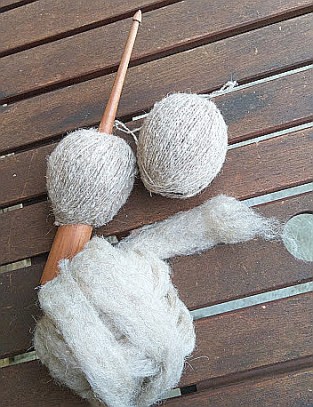 he roving was soft and lofty, but with some coarser guard hairs in it, and quite easy to spin. That’s taking into account the usual droppage. Someone “allergic” to wool – or rather the prickle factor – would probably not appreciate this one but I’m already thinking of how I can incorporate the yarn into a beanie.
 side end. I’ve also found that centre-pull balls/eggs etc from a drop spindle usually don’t work, even if turn them on a ball-winder. Oh well, at least you end up with a couple of egg-shaped cops that don’t need to be wound round a tennis ball before plying.
 The photo shows just how well it turned out using two shades of brown and a red at half strength (all Landscape dyes). Several small samples of that experiment remain, but very little of the blue-grey yarn. The solution? Grey handspun?
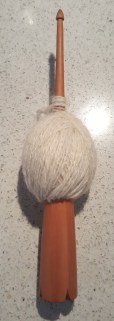 Well, maybe not, but I’ve got one.
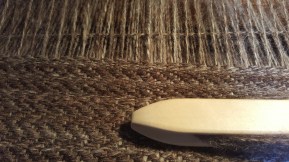 . Most of the yarn was from a fleece in all shades from beige to chocolate, and no doubt from a crossbreed sheep and a beginner spinner; the yarn was spun unevenly and had clearly been done by the same method as my own – stick your hand into the bag and spin whatever comes out, rather than separating the fleece into colours and textures.
 The yarn was singles, so this was plied double, with the resulting average wpi at around 8, so I chose a four-shaft, 3-1 twill at 6epi. At first this seemed as though it may have had to come down to 4 or 5 epi, but the finished item confirms 6 epi was right. The size was calculated at using most of the yarn, although after weaving most of the blanket, I decided that the last ball looked too felted compared with the rest and cut the project short. It had obvi
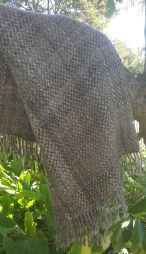 ously come from the short-and-fuzzies of the fleece, while the rest was noticeably coarser and slicker.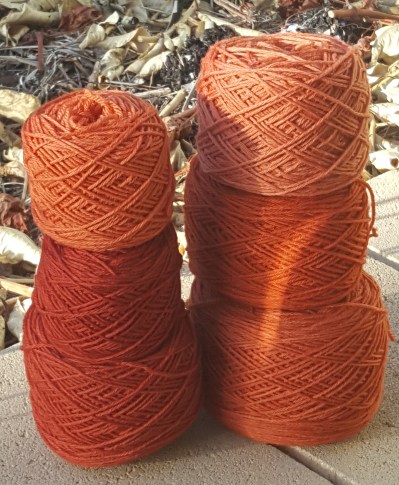
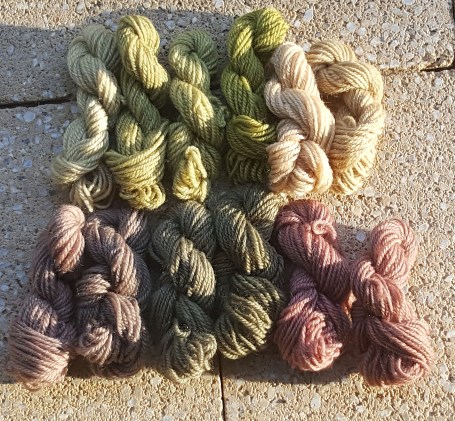
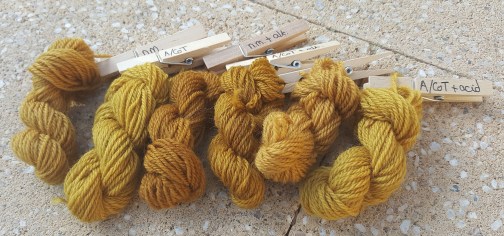 modifier (skeins 3 & 4) darkended the colours, whilst the acid modifier (5 & 6) lightened them. Skeins 1, 3 & 5 demonstrate that no mordant is required. Each shade obtained is, however, worthy in its own right and in real life all are far more vivid.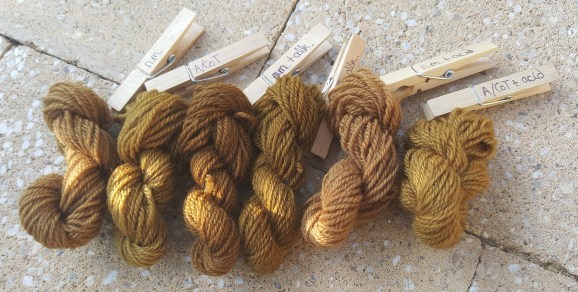
 t.
t. Hedgerow weaver