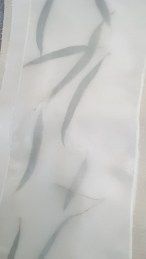
 A while ago I came back from a local op shop with a number of silk scarves and hankies, and leaf prints and indigo in mind. Then this weekend I managed to get hold of some Eucalyptus nicholii leaves, thanks to the local parrots who are currently “pruning” all the local trees and scattering the contents within easy reach. Nice.
I decided on simple and laid one scarf out on a piece of calico, dropping some leaves onto it as though they’d fallen that way, then  placing another scarf on top and wrapping them up in a small bundle. They were placed in the steamer for around two hours, but I can’t be sure of the exact time.
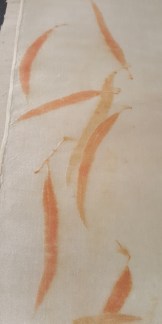 After cooling slightly, the bundle was unwrapped with a pleasing result. The leaf prints appear slightly darker on one scarf, which was opaque, but one the translucent scarf they add to the blowing-in-the-wind effect rather than looking stationary.
Not bad for a first attempt. I did however notice that the prints in the centre of the bundle were paler (where the steam hadn’t penetrated as much) and the tighter end was a little ruffled. Point to remember for next time: wrap around a bamboo cane of at least 1/2″ diameter and steam for longer.
 hree times, before actually asking for them, but then eccentricity took over from reserve and the result speaks for itself.
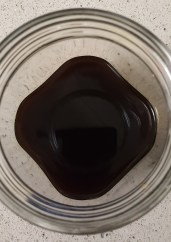 r and damp at the moment, so I wanted to avoid the harvest going mouldy.
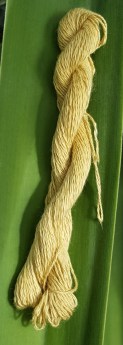 e and with a bit of stirring….. treacle.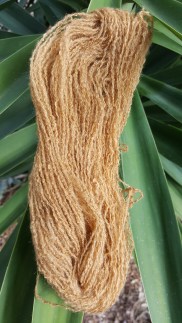
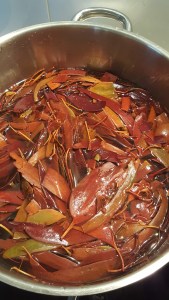 lorry parked on the last remaining patch of undeveloped land had me heading off with secateurs and collecting bag.
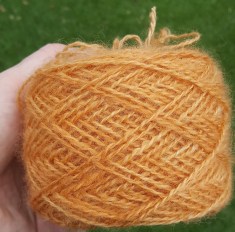 aves were given their own pot to soak in overnight. The next morning, the fresh leaves had started to ferment, and there was a waxy film on the surface and the sides of the pot. Simmering for an hour produced no noticeable colour (just an unpleasant smell), so I turned to the dry leaves. The liquor was already a deep brown before cooking, and after an hour the yarn was added. It had already been in a E. sideroxylon dyepot and had only picked up a smidgen of colour. This time, however, the yarn took on a straw colour.
 E. cinerea is about the only eucalyptus I’ve had success with in the dyepot. Although many sources advise that a mordant isn’t necessary, I wasn’t going to take any chances: 50:50 alum + CoT to 15% wof it was again. The leaves were dry and had been lying at the side of the house for a few months in the hope that some extra sun would improve the colour. They were placed in the pot along with their twigs, normal tap water as opposed to filtered, and simmered for about an hour. The liquid was a pale apricot colour, as opposed to E. sideroxylon which gives a deep, chocolate-red as
 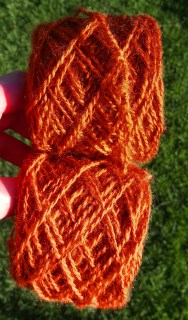 soon as it hits the water.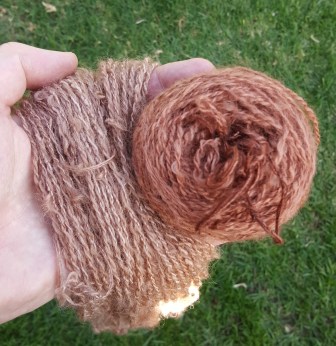
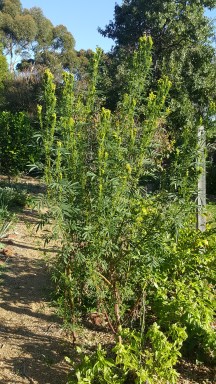 Tagetes minuta, aka Peruvian mint, huacatay, stinking Roger… and a noxious weed in many parts of the world. It does however have some interesting uses: seasoning, herbal tea, medicine, garden stake and dye.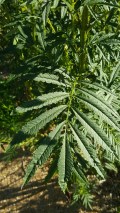
 nmordanted & dyed with 400% wof dried tops, 3 + 4) 50:50 alum-CoT to 15% wof, dyed with 200% fresh tops and 200% dried tops respectively. Once cool, they were washed with soap nuts; there was no noticeable colour loss. You can see that the yarn used to tie the skeins took on more colour.
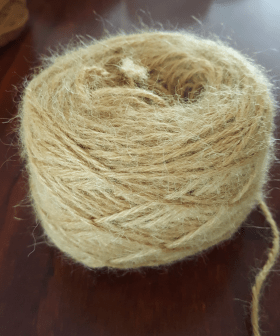
 r about an hour. It took considerably longer than this to strain the liquid through double muslin, but has probably saved even more time that would have been spent trying to get the fine particles out of the yarn. This is destined to be the weft to go with the dahlia-dyed yarn.
 I only had a few small dahlia plants in the garden, but a local enthusiast came to the rescue with what must have been about five kilos of freshly lopped flowers – plenty to experiment with. I don’t know what percentage of the weight of a fresh flower is water, but as they dried, so it became clear that 5kg wasn’t going to go as far as first thought. However, the results were pretty amazing.
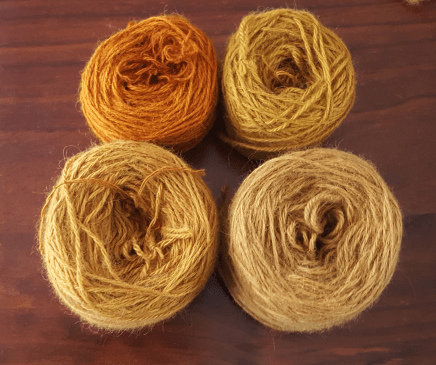 ite alpaca, mordanted with alum at 10% wof. They were simmered for another hour, then one skein was removed. A generous spoonful of bicarb was added to the pot, turning the remaining skein copper. I wasn’t able to repeat the effect with the remaining dyepots, but got very acceptable results nonetheless. The photo shows them paler than real life.
 Hedgerow weaver