After spending some weeks deciding on what exactly we were going to dye with, and then worrying on more than one occasion that the dyes weren’t going to p
erform, last Saturday’s workshop was full of pleasant surprises…
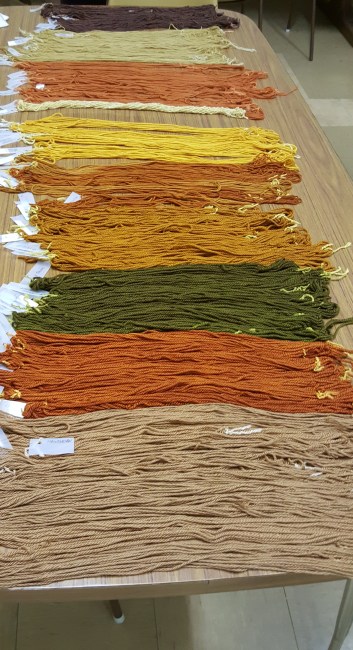
There were seven participants, all friendly and enthusiastic, and all with interesting tales, information and tips to add to the proceedings. The dyes used were (from bottom to top): hawthorn berries, brown onion skins, red onion skins, Tagetes minuta, dahlia flowers, Tagetes lemonii (dried flowers/heads), Eucalyptus cinerea, E. incognita (yep!) and betel nuts.
I didn’t have time to follow Jenny Dean’s recipe (in Wild Colour) for the haws, so boiled up some leaves and twigs for about 40 minutes to get as much tannin in to the dyepot, then added about a kilo of berries and simmered for three-quarters of an hour, then left overnight. This mixture was strained and reheated for the dyeing experiment. They turned the woolen yarn a shade of light brown that I’d never had before, so that’s one for future ref.

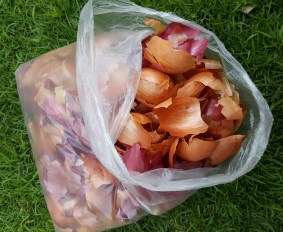
The onion skins were amazing! (right to left: brown onions, red onions, Tagetes lemonii). Even though we used a scant 50% wof, the brown ones dyed a deep copper, while the red ones (close-up below) came out dark, khaki green; the unmordanted ties were lime green, and both without trying. Could it have been the copper pipes at the Guild?
A smaller quantity of dahlia heads than I would have liked gave such a deep colour, and 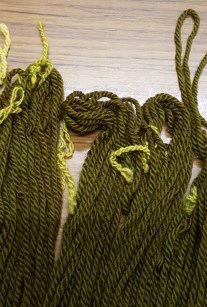 when we dipped half (or more) of the skein back in the liquor with bicarb added, well, even better.
I was concerned that as the tagetes flowers were dry, they’d give muted shades of old gold. Lemonmii gave such a deep sunshine gold that at first I thought it was the brown onions, and the minuta heads could have been fresh – the brightness and intensity of the resulting colour is still a source of amazement.
E. cinerea performed to its usual standard, while the other (maybe a type of peppermint gum?) gave a very pale yellow. Still a good shade to have in the line-up.
The betel nuts? These gave a deeper brown than I’ve ever managed before. None of the pinkish hue, mind. They were, as last time, soaked in water and bicarb for a couple of days.
All in all a successful run of experiments and a great bunch of people to work with!
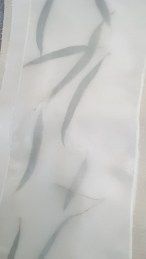 A while ago I came back from a local op shop with a number of silk scarves and hankies, and leaf prints and indigo in mind. Then this weekend I managed to get hold of some Eucalyptus nicholii leaves, thanks to the local parrots who are currently “pruning” all the local trees and scattering the contents within easy reach. Nice.
 placing another scarf on top and wrapping them up in a small bundle. They were placed in the steamer for around two hours, but I can’t be sure of the exact time.
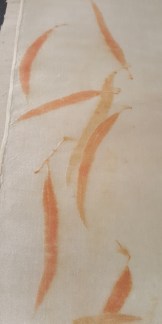 After cooling slightly, the bundle was unwrapped with a pleasing result. The leaf prints appear slightly darker on one scarf, which was opaque, but one the translucent scarf they add to the blowing-in-the-wind effect rather than looking stationary.
 hree times, before actually asking for them, but then eccentricity took over from reserve and the result speaks for itself.
 ng didn’t work, as at the bottom end there are a lot of shorter, finer fibres. With combing, I was able to remove these and set them aside to see what they spin up like. I’ll probably scour them and then put them through the wool combs.
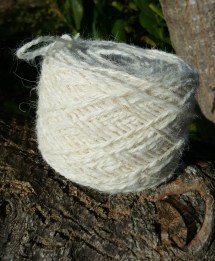 asy to manage, and quick to spin and ply. The resulting yarn is quite pleasing for a first attempt – definitely too coarse for much other than a carpet, but still with a degree of softness. After scouring the skein, it came out whiter than white. I look forward to seeing how well it takes dye.
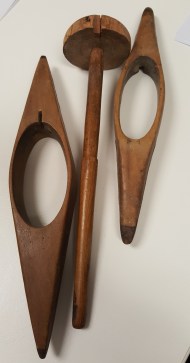 Every now and again I’m lucky enough when a friend or colleague (or both) shows me something fibre- or craft-related that belonged to a relative, or was made by a relative. Fibre-crafts and social history, the perfect mix!
 or catching the evening meal. All were at least eighty years old.
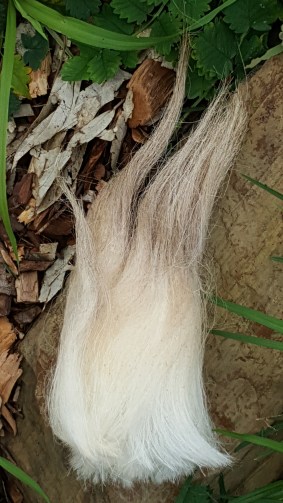 less than 10km from home.
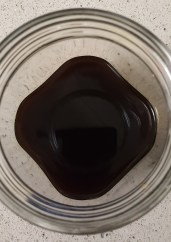 r and damp at the moment, so I wanted to avoid the harvest going mouldy.
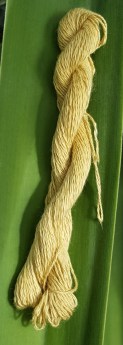 e and with a bit of stirring….. treacle.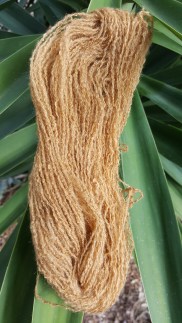
 lorry parked on the last remaining patch of undeveloped land had me heading off with secateurs and collecting bag.
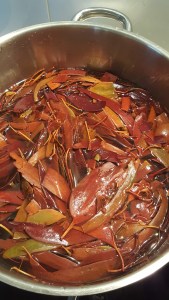
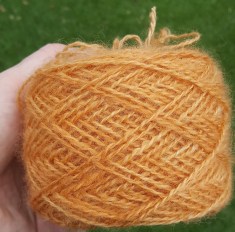 aves were given their own pot to soak in overnight. The next morning, the fresh leaves had started to ferment, and there was a waxy film on the surface and the sides of the pot. Simmering for an hour produced no noticeable colour (just an unpleasant smell), so I turned to the dry leaves. The liquor was already a deep brown before cooking, and after an hour the yarn was added. It had already been in a E. sideroxylon dyepot and had only picked up a smidgen of colour. This time, however, the yarn took on a straw colour.
 E. cinerea is about the only eucalyptus I’ve had success with in the dyepot. Although many sources advise that a mordant isn’t necessary, I wasn’t going to take any chances: 50:50 alum + CoT to 15% wof it was again. The leaves were dry and had been lying at the side of the house for a few months in the hope that some extra sun would improve the colour. They were placed in the pot along with their twigs, normal tap water as opposed to filtered, and simmered for about an hour. The liquid was a pale apricot colour, as opposed to E. sideroxylon which gives a deep, chocolate-red as
 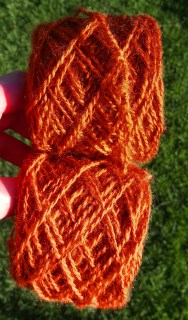 soon as it hits the water.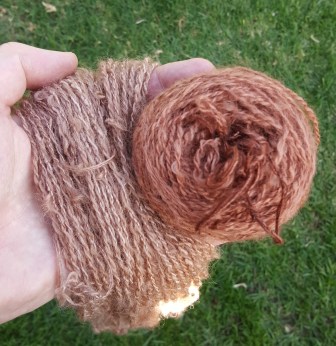
 Hedgerow weaver