Eucalyptus shawl

euc shawl 1Dolly’s second outing on the same day was to model a shawl. Before I go any further, I should point out that this is not some weird fetish; the model is named after a real-life character from childhood visits to my grandparents’ in Battersea. No resemblance other than the name.

The pattern is Alina Appasova’s Pinwheels Lace Shawl on Ravelry, and the yarn is handspun Finn x English Leicester. The fleece had so many different qualities of wool, and typically instead of spreading the fleece and separating them, I flicked and spun several locks at a time before moving on to a different location in the bag. The pattern and the yarn gave a springy, lacy knit that holds its shape and is definitely for cold season wear.

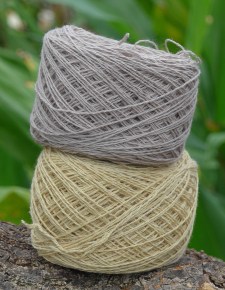
The yarn was dyed with Eucalyptus cinerea, sideroxylon, nicholii, amplifolia (the latter overdyed – euc shawl2see post below), and some of these blended. I had no idea how the colours would go together, and how I would achieve this, so in the end just went for knitting to the pattern until one ball ran out and choosing another, going down the scale from red to brown, dark to light, and finishing with darker and redder again. It worked.

This was given to the same recipient as the Wuthering Heights scarf, but as a birthday present in advance (to make up for the other one being late).
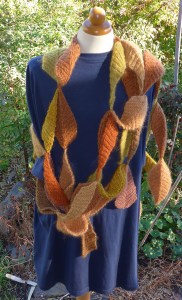
Wuthering Heights scarf

Last year I knitted a fair number of leaves from handspun (my own and a couple of balls of op-shopped) that had been dyed with plants and flowers etc. mentioned earlier in the blog. The pattern was from Crafty Galore .  It took considerably more time (until very recently) to decide how to arrange these together, and sew them, to make a scarf. So Kate Bush didn’t wear one in the video, anWH Scarf2d she wasn’t walking through a forest in autumn, but you can imagine…WH Scarf1

The leaves were sewn tip to stem, and arranged in a more-or-less plaited format. Worn, it can be draped rows-together or opened up more as a shawl. Either way, it was appreciated as a belated Christmas present and immediately coveted. Methinks this will be a one-off, however.


Eucalyptus amplifolia

The only specimen of E. amplifolia (ssp. amplifolia) I could find was a rather tall tree with branches high up and all fresh leaves out of reach. There were however plenty of dead leaves on the ground that hadn’t started to rot, so I scooped these up and went home with a bag full.

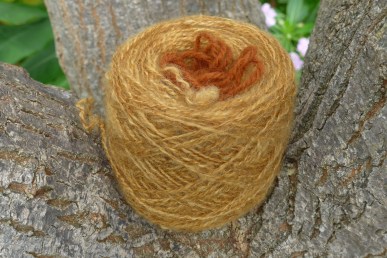
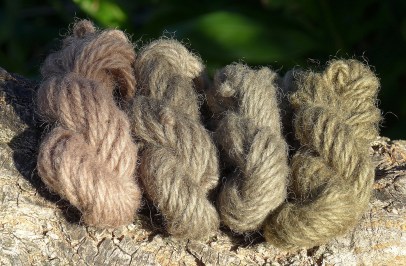
I simmered the leaves for a while, with a E amplifolia1small skein (a tie, really) of commercial yarn thrown in (see centre of ball) – this came out a deep brown which was what I had been aiming for after consulting a couple of sources. The next day I added a full skein of handspun, plus two other ties of the commercial, simmered them for well over an hour and waited for the same brown.
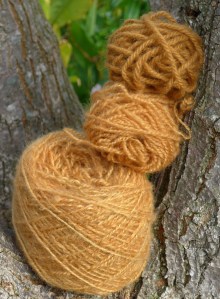
As you can see, the handspun came out an uninspiring shade of mustard (I’ve since overdyed it with E. sideroxylon). The two ties, which have gone walkabout, came out two different shades of brick red. Conclusion? That the handspun, although carefully scoured, hadn’t been processed nearly aE amplifolia2s much as the commercial and therefore wasn’t as receptive (porous?). It was also thinner, and translucent.
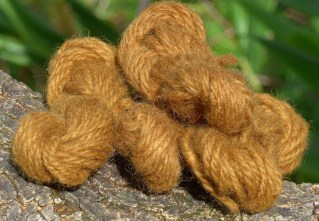
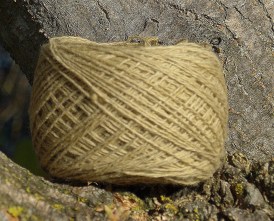
More recently I repeated the experiment with a second collection of un-rotted leaves of the same tree. The handspun came out of the dyepot in two different shades of honey brown, while the commercial was darker honey, but nowhere near as dark as the first experiment. Maybe the leaves were more rotten than I thought?

I also experimented (some time between the two other lots) with no-/mordant and/or modifier to see if there was much difference.E amplifolia3 Barely noticeable, so not one to repeat when contrast is called for.
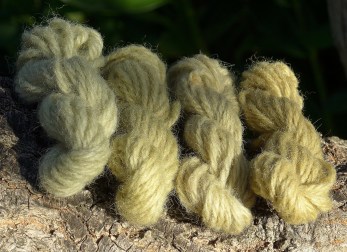
There were a couple of small branches on the ground with fresh leaves that the parrots had been at, but not really enough to dye a skein with. Might try some leaf prints with these.

Dahlia leaves

feuilles de dahlia, Dahlienblätter, hojas de dalia, duilleoga dáilia

My experiment with tree dahlia leaves last year didn’t do well, producing no colour at all, but I decided to try again with the bedding dahlias. They were going into dormancy, so left enough leaves on each plant to provide the final feedahlia leavesd for the tubers.

The results were some interesting pastel green and yellow pastel hues which I usually term “’50’s colours” after childhood memories of old pots of paint in discontinued shades and bedclothes/clothes/tablecloths (I did know the difference, believe me, and used them all for the correct purpose, except when playing Batman) that maybe used to be darker or perhaps just weren’t as gaudy as in the 60’s/70’s.

Woad seeds

Isatis tinctoria, guède, Waid, isatide, glaisin

Although I had to use half my harvest of woad seeds (40g is a lot of seeds), I still have plenty to sow for next season’s leaf harvest, with some of the previous season’s self-sown plants to provide the next lot of seeds. I didn’t get around to harvesting any leaves this summer, but doggie seems to like using them as an outdoor bed. She’s quite good at nudging out the stakes and bailer twine barriers that were supposed to keep her and the birds off.

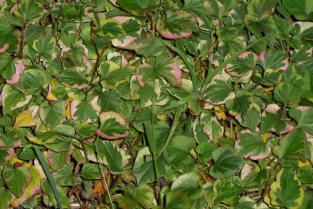
Back to the seeds in question. I simmered them for about 45 minutes, strained the liquor and added the yarn for another 45 minutes’ simmering. The mordants and modifiers all produced greener shades, with onlwoad seedsy the unmordanted/unmodified yarn giving a pinky-brown.
Looking at the three on the right, my mind’s going back to episodes of Outlander, although if I do get around to weaving a plaid, I might forgo the waulking with a bucket of wee (says he who pokes his bare hand into the compost heap to see how it’s doing).


Houttynia cordata

chameleon plant, plante caméléon, chinesischer Eidechsenschwanz, lus chameleon

After hearing the salesperson in a Sussex nursery talk about an orange-scented plant yonks ago, mater et filius, aka the two family plant-freaks, waited for the customers in front to put it down before we sniffed and bought. The Vietnamese say this plant smells of fish, but all I can smell is Nell Gwyn’s hands after a packed-out sitting in Drury Lane.

houttynia1As it survives English winters, South Australian summers and everything the tropics has to offer, I’d say it’s pretty easy to grow and tolerant of most climates.
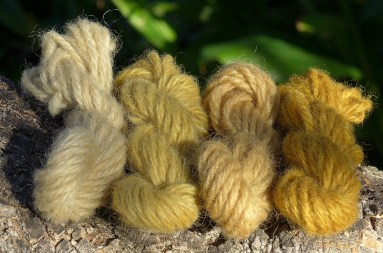
I recently saw this plant mentioned on a website about traditional carpet dyes (and can’t for the life of me find where I bookmarked it), and so pulled up several handfulls – it’s had a good year – and filled up another dye pot.

I usually add the leaves to Vietnamese-style cold rolls and salads, so was eager to find out just how good a dye it is. As it was simmering, there was the aroma of Nell Gwyn’s hhouttyniaands in the laundry room, but nothing overpowering.
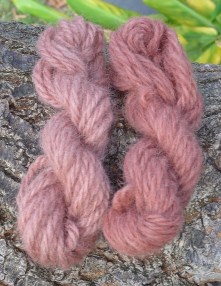
And the findings? Alum/CoT mordant definitely required, and an alkaline modifier brings out the full colour. In real life, the skein on the far right is more of a turmeric colour, full and rich. I’m eager to test this one for light- and wash-fastness.

Hollyhocks

Alcea, trémière, Malve, malvarrosa, leamhach beannaithe

I’d been saving the heads of my one dark purple hollyhock for over a year. Why only one? They always seem to get rust and then grow stunted. Either that or the insects bore into the buds before the flowers open.

Anyway, about 60g of dried heads (petals only; no green bits) were soaked in cold tap water for most of the day, then simmered for about an hour. The liquid was viscous and smelt rather jammy. Nice!Hollyhocks

After straining, 6 x 5g skeins were simmered in the liquor for another hour. The first two (far left) were removed (no mordant, alum + CoT), then two of the same ilk (middle) were dropped into a jar of the liquor + a slug of vinegar which altered the shade of the mordanted yarn from brown-with-a-hint-of-green to brown-with-a-hint-of-pink . The last two were left in the pan and had a spoonful of bicarb added. Alchemy! Two shades of gobsmacking moss green!

Dock seeds 2

Rumex spp, oseille, Ampfer, acedera, copóg

I was determined to try again for the red that is to be had from dock seeds, so tried fermenting some in water for a few days. Having read about alcohol extraction of Turkey Red, I later steeped 40g seeds in 300ml meths (+ water) for a few days, and then some more in water + ammonia.

dock seeds1The first two skeins were both unmordanted. The seeds were steeped in tap water for about five days. There was a whitish film on the surface of the water, so I decided it was either dye straight away or boil the mixture to kill off any mould, and risk losing the colour. The mixture was simmered for about an hour (maybe more) and was clearly reddish. The liquor was then strained over the skeins, and simmered for a further hour. It still looked red, so I tried adding some vinegar to see if this would help. It looked as though I’d simply diluted the colour, so added some bicarb quickly to offset the acid. The foam on top of the liquor was quite red, but the skeinsdock seeds2 typically didn’t take on this depth of colour. Still, it’s the closest to red I’ve achieved so far.
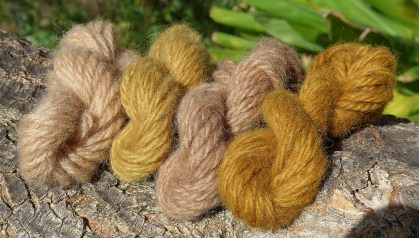
I tried another lot in tap water and decided it was time to use them when the mixture started to smell of wee. I followed my usual routine of unmordanted, alum + CoT, unmordanted + alkaline modifier – bicarb, [alum + CoT] + alkaline modifier. The results were very different to the first try. The seeds were picked in different locations and the second lot may have had more natural water due to rain (the first lot dock seeds3came from.the side of the freeway).

And those steeped in alcohol? No reds, but deeper colours than the second batch. I’ll try again next year and will harvest some unripe seeds on their stalks. Worth a go, and as they’re a weed it won’t matter.

Those steeped in water + ammonia had a skein of cotton yarn thrown in and left for a few days. Although the liquor was very dark, there was barely a trace of colour on the yarn after rinsing. Now, to dig up some dock roots…

Pomegranate on cotton yarn

pomegranate1

I copied my last year’s experiment with pomegranate rind on cotton yarn (bottom), and added bicarb to the liquor. The result was a light mustard-yellow. As the rind was a mixture of yellow and red, I decided to try again with red-only rind (the pomegranate was red all over, as the ones imported from the US tend to be), and added (I think…) ammonia to the liquor.

You couldn’t see through the jpomegranate2ar when held up to the light, and the yarn (top) – c.12g – came out a grey-mauve after washing. Still not a very deep shade, but it demonstrates the variety that can be obtained from the fruit.
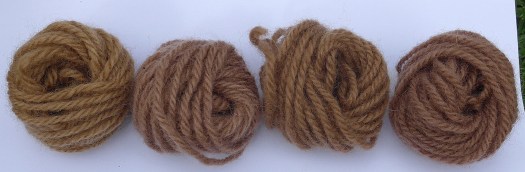
As the dye liquor was still dark, another skein of cotton went in, but this time came out a “dirty yellow”. None of the skeins had any mordant, so this plus some modifiers might be the subjects of the next experiments.

Phormium tenax – NZ flax

I came across a NZ flax plant with some seed heads (mostly empty) and removed as many as I could. My own plant is still young, and the garden centres only seem to carry varieties with colourful leaves rather than the species. I’ve sown a few seeds that remained in the pods and will see how they grow. I notice these plants every time I go back to England – there was even one growing on Brighton Beach (clearly a landscape planting rather than self-sown), so they must be extremely hardy to tolerate both SA summers and English winters along with salt spray.

phormium1

The Woolcraft Book states that you can get a purple-brown colour from the pods with a copper modifier, but I just stuck to the usual alum/CoT and alkaline modifier routine. The book also mentions allowing the pods to ferment for a period of time, and warning of the offensive odour. I left them soaking in plain tap water for about 5 days; the black dye came out of the pods quickly, but I’m not sure whether the 5 days added to the effect. There was no smell, but perhaps that was due to the lower temperatures, now that we’re in autumn.

The alum/CoT mordant (samples 2 & 4) transformed the yellow-brown to a more pinky-brown, whereas the alkaline modifier (samples 3 & 4) deepened the shades. I hope to eventually have more of the resource to play with and also to try processing the fibre.