Hollyhocks

Alcea, trémière, Malve, malvarrosa, leamhach beannaithe

I’d been saving the heads of my one dark purple hollyhock for over a year. Why only one? They always seem to get rust and then grow stunted. Either that or the insects bore into the buds before the flowers open.

Anyway, about 60g of dried heads (petals only; no green bits) were soaked in cold tap water for most of the day, then simmered for about an hour. The liquid was viscous and smelt rather jammy. Nice!Hollyhocks

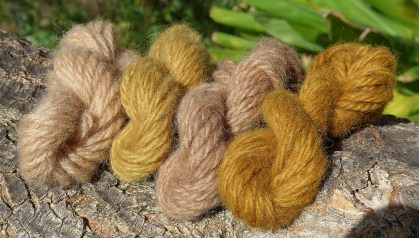
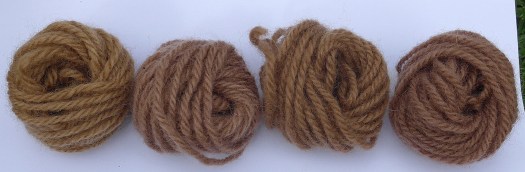
After straining, 6 x 5g skeins were simmered in the liquor for another hour. The first two (far left) were removed (no mordant, alum + CoT), then two of the same ilk (middle) were dropped into a jar of the liquor + a slug of vinegar which altered the shade of the mordanted yarn from brown-with-a-hint-of-green to brown-with-a-hint-of-pink . The last two were left in the pan and had a spoonful of bicarb added. Alchemy! Two shades of gobsmacking moss green!

Dock seeds 2

Rumex spp, oseille, Ampfer, acedera, copóg

I was determined to try again for the red that is to be had from dock seeds, so tried fermenting some in water for a few days. Having read about alcohol extraction of Turkey Red, I later steeped 40g seeds in 300ml meths (+ water) for a few days, and then some more in water + ammonia.

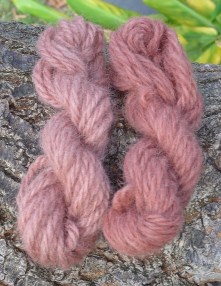
dock seeds1The first two skeins were both unmordanted. The seeds were steeped in tap water for about five days. There was a whitish film on the surface of the water, so I decided it was either dye straight away or boil the mixture to kill off any mould, and risk losing the colour. The mixture was simmered for about an hour (maybe more) and was clearly reddish. The liquor was then strained over the skeins, and simmered for a further hour. It still looked red, so I tried adding some vinegar to see if this would help. It looked as though I’d simply diluted the colour, so added some bicarb quickly to offset the acid. The foam on top of the liquor was quite red, but the skeinsdock seeds2 typically didn’t take on this depth of colour. Still, it’s the closest to red I’ve achieved so far.

I tried another lot in tap water and decided it was time to use them when the mixture started to smell of wee. I followed my usual routine of unmordanted, alum + CoT, unmordanted + alkaline modifier – bicarb, [alum + CoT] + alkaline modifier. The results were very different to the first try. The seeds were picked in different locations and the second lot may have had more natural water due to rain (the first lot dock seeds3came from.the side of the freeway).

And those steeped in alcohol? No reds, but deeper colours than the second batch. I’ll try again next year and will harvest some unripe seeds on their stalks. Worth a go, and as they’re a weed it won’t matter.

Those steeped in water + ammonia had a skein of cotton yarn thrown in and left for a few days. Although the liquor was very dark, there was barely a trace of colour on the yarn after rinsing. Now, to dig up some dock roots…

Pomegranate on cotton yarn

pomegranate1

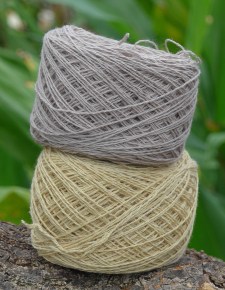
I copied my last year’s experiment with pomegranate rind on cotton yarn (bottom), and added bicarb to the liquor. The result was a light mustard-yellow. As the rind was a mixture of yellow and red, I decided to try again with red-only rind (the pomegranate was red all over, as the ones imported from the US tend to be), and added (I think…) ammonia to the liquor.

You couldn’t see through the jpomegranate2ar when held up to the light, and the yarn (top) – c.12g – came out a grey-mauve after washing. Still not a very deep shade, but it demonstrates the variety that can be obtained from the fruit.

As the dye liquor was still dark, another skein of cotton went in, but this time came out a “dirty yellow”. None of the skeins had any mordant, so this plus some modifiers might be the subjects of the next experiments.

Phormium tenax – NZ flax

I came across a NZ flax plant with some seed heads (mostly empty) and removed as many as I could. My own plant is still young, and the garden centres only seem to carry varieties with colourful leaves rather than the species. I’ve sown a few seeds that remained in the pods and will see how they grow. I notice these plants every time I go back to England – there was even one growing on Brighton Beach (clearly a landscape planting rather than self-sown), so they must be extremely hardy to tolerate both SA summers and English winters along with salt spray.

phormium1

The Woolcraft Book states that you can get a purple-brown colour from the pods with a copper modifier, but I just stuck to the usual alum/CoT and alkaline modifier routine. The book also mentions allowing the pods to ferment for a period of time, and warning of the offensive odour. I left them soaking in plain tap water for about 5 days; the black dye came out of the pods quickly, but I’m not sure whether the 5 days added to the effect. There was no smell, but perhaps that was due to the lower temperatures, now that we’re in autumn.

The alum/CoT mordant (samples 2 & 4) transformed the yellow-brown to a more pinky-brown, whereas the alkaline modifier (samples 3 & 4) deepened the shades. I hope to eventually have more of the resource to play with and also to try processing the fibre.

Avocado pits and skins on cotton

I’ve been saving avocado pits and skins for a number of months, but the contribution from a colleague (thanks, Rhonda!) far outweighed – literally – the amount that I got through over the summer.

The pits were halved, sliced, then either dried or frozen; the skins were ripped into smaller piece, then dried. The dye liquor was made by soaking the relevant parts in water, then adding either bicarb or ammonia, then steeping the cotton yarn in this for a few days.

The photo, as always, doesn’t really show the true colours, especially as we’re in autumn and the sky is overcast, but the bottom row were all attained by adding bicarb to draw out the red. The yarns all turned out various depths of pale pink.

avocados

With the two on top, the left was from 20g dried skins (purple ones) soaked for a few days, then for a few days more with ammonia, then a few more again with the yarn. In real life, it’s slightly darker.

The one on the right was from 100g frozen, sliced pits following the same method above. The ammonia definitely brings out a deeper shade.

Now, what to do with with five balls of cotton in antique pink? Actually, I’ve thought of one use, but that’ll have to wait.

Heliopsis

Heliopsis helianthoides, hélops, Sonnenaugen, girasol falso

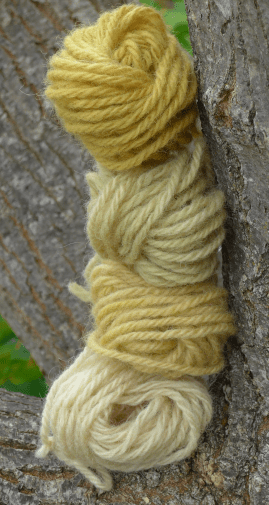
And there’s more… The bright, sunshine yellow flowers of the heliopsis were definitely worth saving, retaining the colour even when dried; the petals tend to wrinkle without browning. I’m not sure how many grams went into the pot (following the same procedure as the dahlias, zinnias and yarrow below), maybe about 60g?heliopsis

The only shade that really stands out is number 4, so as with the zinnias, future use will depend on light- and wash-fast testing . As garden plants, however, these take the summer heat and dryness well. I originally had doubles, but then a single appeared in the clump, so maybe they reverted. Either way, the colour’s still there.

Yarrow

Achillea millefolium, achillée, Schafgarbe, milenrama, athair thalún

I had to pull most of the yarrow out as it was taking over, and growing under the rose bush meant any attempt to keep it tidy was quite a prickly experience, so out it came leaving plenty of dye material to play with!

yarrow2

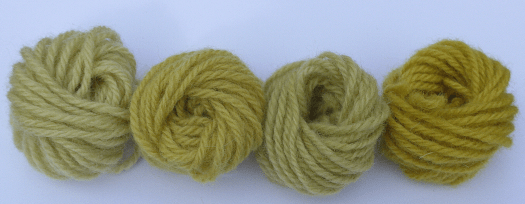
The stalks dried well and were chopped, stored in an old coffee jar and forgotten for a while. I didn’t bother weighing them, but estimate there was at least 200% wof. It was simmered for about an hour, strained, then the yarn was added. Similar to the other recent experiments the skeins were, left to right: no mordant, 8%/7% alum/CoT, no mordant + alkaline modifier, alum/CoT mordant + alkaline modifier.

The modifier (bicarb) turned the green skeins yellow, similar to many other garden dye plants. The original green (without mordant), however, is one colour I’ve never attained before and one to try again soon using a higher %wof to get a deeper shade.

Zinnias

zinniasAnother bumper crop came from my first (successful) attempt to grow zinnias: these were dark pink and pink/apricot. In the height of summer, these dried to about 1/5 of their size and lost most of the colour. Those picked at the end of summer lost about 1/2 of their size and retained most of their colour. I chose the latter to experiment with and used about 100g; I’ll try with the faded ones at a later date.

As with the dahlias, the alum/CoT brought out the yellow, and the bicarb modifier intensifiedmonarch the shade.

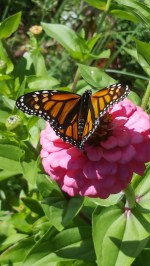
Would I use zinnias again over other dye plants that give yellows? This’ll depend on the results of the wash-fast and light-fast tests to come. As for growing them, the monarch butterflies love them and they tolerate the summer heat admirably.

Dahlias 2

I bought a punnet of bedding dahlias two summers ago (and again this summer just gone); they turned out light pink, dark pink, cerise, yellow and bronze, and produced an abundance of flowers even on plants only 1′ – 2′ high, so will stick to these in future rather than growing the taller varieties that need staking and perhaps more shade.

Thanks to a generous harvest, I was able to dye with both flowers (dried) and heads (minus the petals) to see if there is any difference – it’s stated in The Woolcraft Book that the colour is in the centre of the flowers.

dahliasx3

The top row are the flowers (100g dried), the bottom row the heads only (200g fresh). From left to right: no mordant, alum/Cot 8%/7%, no mordant plus alkaline modifier (bicarb), alum/Cot mordant plus alkaline modifier. The yarn was pure white, triple knit (never heard of that before) NZ virgin wool – a lucky find in a local op shop. The skeins weighed about 5g each.

The flowers clearly produced deeper shades, but maybe the quantity of viable dyestuff was greater considering how much % of the heads was water.

I’m often asked by fellow Guild members, “What about tree dahlias?” I tried experimenting with the leaves last year after one of the canes blew down, but with disappointing results. However, I’d saved the flowers from that cane and they’d been hanging in a bag on the washing line for the best part of a year – dried, shrivelled and light brown.
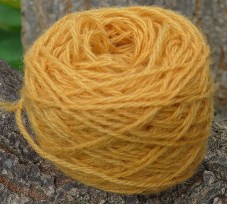
tree dahliaX2They produced a tea-coloured liquor after simmering for about 3/4 hour, so I decided to go ahead. Had I mordanted the yarn? Couldn’t remember, so I just dropped a skein in the pot. After about 30 mins I added a pinch of alum, and the yarn turned visibly darker. That answered my question. Then some bicarb turned the yarn a rich orange-yellow (deeper than in the photo). So, that answers the other question and I shall be saving as many flowers/heads as I can this year.
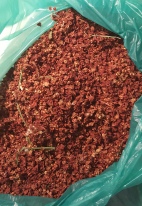
Dock seeds

I finally got round to dyeing the skein of yarn to contribute to the Ethel Mairet project at the Ditchling Museum. I’d already tried dyeing with dock roots, but the yarn came out muddy yellow withdockseeds added patches of mud (next time I’ll peel the roots). For the project I decided to try the seeds. I’d read in The colour cauldron (Su Grierson) that a red colour could be obtained by boiling the seeds successively over a few days. Tempting…
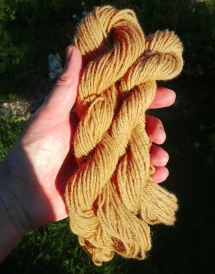
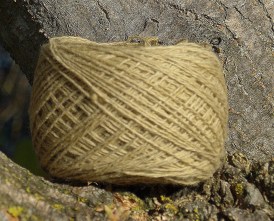
I managed to pick 70g of seeds whilst out walking on one of the many local reserves. The seeds were boiled for about an hour at a time for 4 days in total. The water didn’t change colour much, but I keep reminding myself that what you see is not usually what you get. The yarn was sheep’s wool, dockyarnmordanted with 8% alum/7% CoT wof, boiled for an hour or so, then left to cool overnight.

The picture shows the yarn (right, together with another woollen yarn) several shades lighter than reality (we’ll go for medium-dark beige), but still not the red I was hoping to get. Maybe tap water + (sub-)species + soil + rainfall + other variables? I’ll try again, but maybe with some copper added to the water and later in the season. Still, a worthwhile experiment.