Anchusa tinctoria, orcanette, rothe Ochsenzunge, alcana, boglas
I don’t think I’ve had quite as much linguistic fun and dyepot surprises from any one plant before. While looking up names of alkanet in other languages, I went from English through Irish to ancient Greek, then back to German and Swedish. Let me explain…
The variety/varieties of Anchusa and related genus Pentaglottis are known in northern Europe as either bugloss or ox tongue. I couldn’t find one source that would tell me the name of Anchusa tinctoria in Irish/Gaelic (though I did come up with scorsa luibh, then found I couldn’t verify this anywhere else), so wondered if perhaps bugloss came from the Irish bog/bogach + glas = green o’ the bog – that’s my name, not one I found somewhere else). Well, no. It appears that bugloss actually comes from Old French, from Latin, from ancient Greek and means “ox tongue”. Well, at least it would have fitted in nicely with Irish and not stuck out like a sore thumb… Nach bhfuil mo bhuglas alainn an bhliain seo! Any genuine gaeilgoir is welcome to make corrections here and should make allowances for a sassenach gan m(h)úinteoir.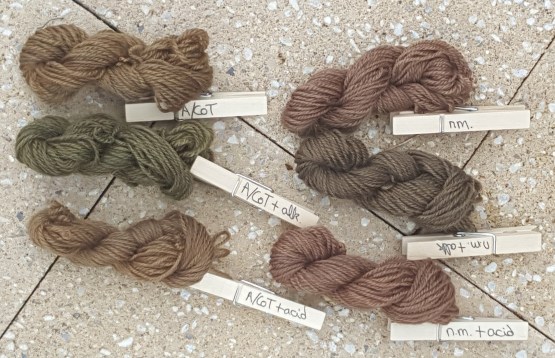
OK, back to the dyepot… In an earlier post, I’d obtained pure black from steeping the roots in alcohol. This time I tried steeping the roots in water alone for a week, then doing the usual. The results were quite surprising, considering two Guild buddies had come up with purple and grey. All the shades o btained were quite distinct, but the most notable results were that no mordant keeps the red, whilst an alkaline modifier transforms the reds to green shades. Here’s an intersting source if you’re interested in the chemistry: green alkanet
So what happened to the purple? Have a look at the spoon which I hadn’t de-gunked before stirring. I may very well give this one more go before I give up. Beirthe nó caillte…
 left them alone.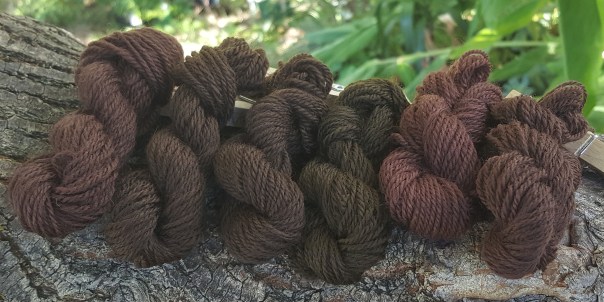

 (bicarb) brought out more brown, whereas the acid (vinegar) brought out a redder tone.
 s a smaller bunch growing near my local station, so a-harvesting I went.
 The mordanted yarns came up more yellow, or rather a more intense (albeit slight) shade of the same mustardy-yellow. I wonder if the texture of the yarn had anything to do with refraction (the yarn is now at the end of the ball and is a lot more open, like singles rather than plied).
 Every year I tell myself I won’t enter the Royal Show this year, but then make a last-minute decision to put something in. This year I decided I needed to get back into weaving (hadn’t done any for at least six months), so bought two entries and ended up entering one.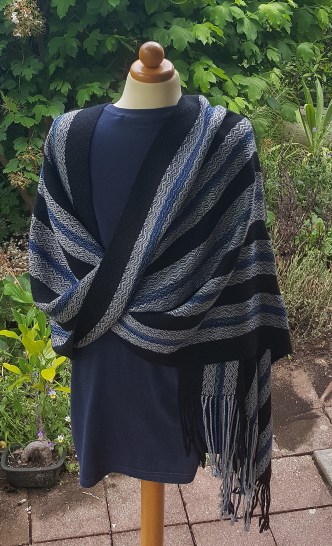
 The warp was black wool (plied, commercially spun at a sett of 16 epi) and silver-grey and lake combo 8/2 tencel (24 epi). The weft was black 8/2 tencel. The original draft required a sett of 27 epi, but 24 epi and the use of wool made for a lighter, airier and more wrapable shawl. I’ll definitely be using this combination again.
 Dolly’s second outing on the same day was to model a shawl. Before I go any further, I should point out that this is not some weird fetish; the model is named after a real-life character from childhood visits to my grandparents’ in Battersea. No resemblance other than the name.
 see post below), and some of these blended. I had no idea how the colours would go together, and how I would achieve this, so in the end just went for knitting to the pattern until one ball ran out and choosing another, going down the scale from red to brown, dark to light, and finishing with darker and redder again. It worked.
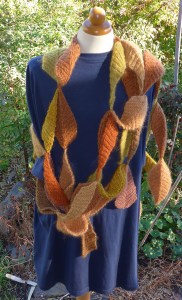 d she wasn’t walking through a forest in autumn, but you can imagine…
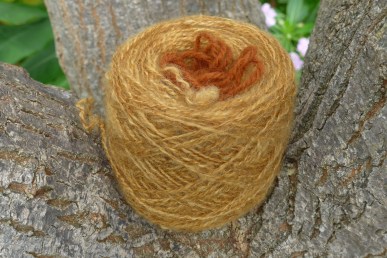 small skein (a tie, really) of commercial yarn thrown in (see centre of ball) – this came out a deep brown which was what I had been aiming for after consulting a couple of sources. The next day I added a full skein of handspun, plus two other ties of the commercial, simmered them for well over an hour and waited for the same brown.
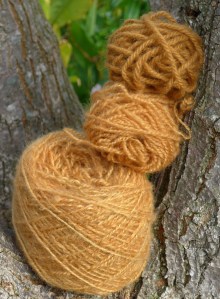 s much as the commercial and therefore wasn’t as receptive (porous?). It was also thinner, and translucent.
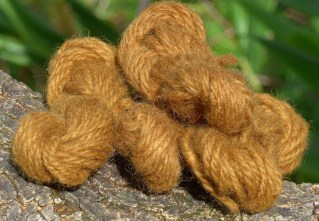 Barely noticeable, so not one to repeat when contrast is called for.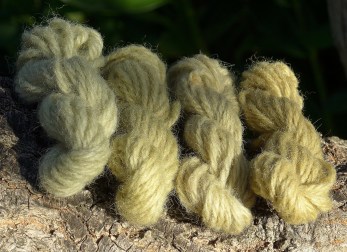
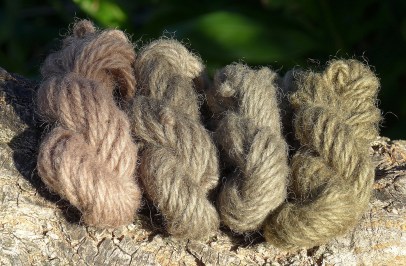 y the unmordanted/unmodified yarn giving a pinky-brown.
 Hedgerow weaver