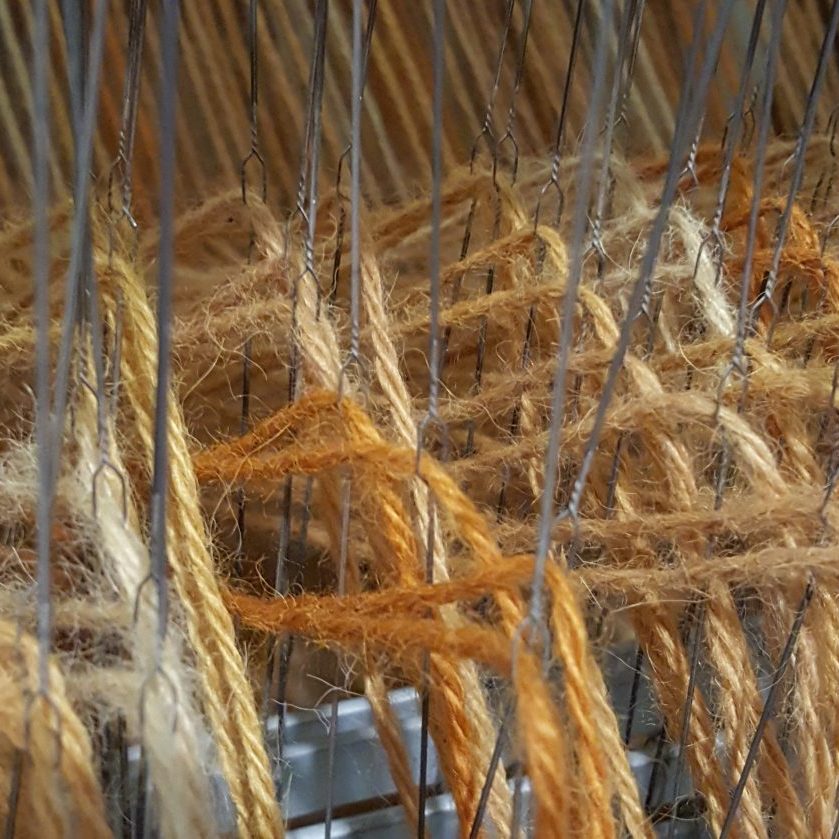
Punica granatum, écorce de grenade, Granatapfelschale, cáscara de granada, craiceann pomegranáit
I’ve had quite a stock of dried pomegranate peel sitting around in the larder (I refuse to call it a “pantry” as most Australian-born do – sounds too much like something out of Upstairs Downstairs and we don’t have a maid). So, after obtaining a beige tone on alpaca yarn some time ago, I wasn’t expecting anything more.
I used 200% wof on wool, and chose the bits of rind with the reddest colouring. The alkaline 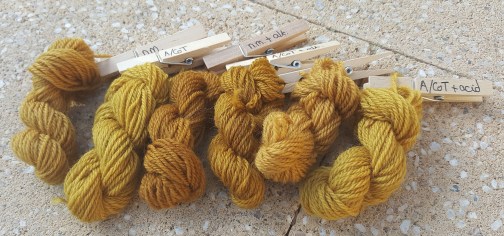 modifier (skeins 3 & 4) darkended the colours, whilst the acid modifier (5 & 6) lightened them. Skeins 1, 3 & 5 demonstrate that no mordant is required. Each shade obtained is, however, worthy in its own right and in real life all are far more vivid.
I had read somewhere that pomegranate, being high in tannin, is also worth consideration in making turmeric more light-fast… Wonder what it will do for alkanet? I just had to try, so in the dye bath mentioned in the previous post, six doppelgangers (that doesn’t seem right without the umlaut, aber ich bin sicher, Ihr konnt es mir vergeben) were thrown in for an overdye.
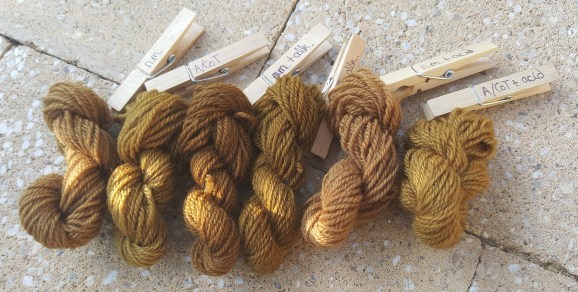
The original shades of pomegranate alone were strong and I suppose I should’ve repeated the experiment with yellow rind, and maybe at 100% wof. Oh well, let’s just shove some skeins in the pot and see what we get…
…more interesting shades with pinky (and perky) overtones. The light-fast testing will be interesting. Tomorrow’s been downgraded to 41oC (how cool…) whilst Sunday is still forecast to be 42oC. Even if it stays below that, there’s plenty of UV around for the tes t.
t.
Just as an aside, I “marked” the pre-dyed pomegranate skeins with some bits of other wool. How did they emerge from the alkanet bath? GREY AND PURPLE! Grr!!!
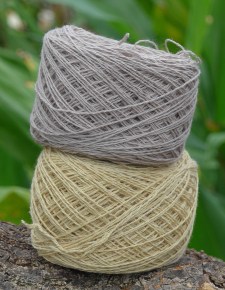
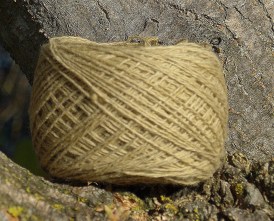 ar when held up to the light, and the yarn (top) – c.12g – came out a grey-mauve after washing. Still not a very deep shade, but it demonstrates the variety that can be obtained from the fruit.
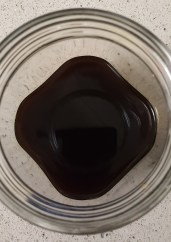 r and damp at the moment, so I wanted to avoid the harvest going mouldy.
 e and with a bit of stirring….. treacle.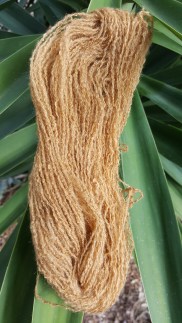
 I only had a few small dahlia plants in the garden, but a local enthusiast came to the rescue with what must have been about five kilos of freshly lopped flowers – plenty to experiment with. I don’t know what percentage of the weight of a fresh flower is water, but as they dried, so it became clear that 5kg wasn’t going to go as far as first thought. However, the results were pretty amazing.
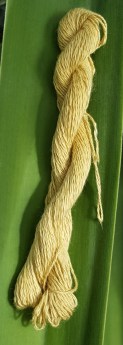
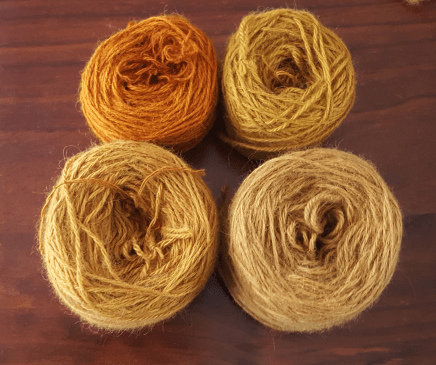 ite alpaca, mordanted with alum at 10% wof. They were simmered for another hour, then one skein was removed. A generous spoonful of bicarb was added to the pot, turning the remaining skein copper. I wasn’t able to repeat the effect with the remaining dyepots, but got very acceptable results nonetheless. The photo shows them paler than real life.
 Hedgerow weaver