Sugar gum, l’eucalyptus de sucre, Zuckereukalytpus, eucalipto de azúcar, an  eoclaip siúcra
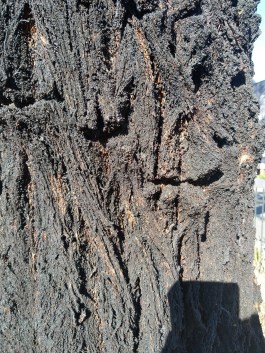
Impressive is just one word I’d use to describe the sugar gum: tall, thick, smooth, glaucous, striking… I’ve never knowingly seen a young specimen; all the ones I know are very tall with distinct markings on the trunk. Impressive…
Our local specimens have never shed many leaves, although I did manage to gather a couple of handfuls this week. One specimen has some low-growing foliage, but I can’t excuse pruning it for the sake of the dyepot. Dictated by the current season, there is however a significant amount of fallen bark to be had, so bark it was (aided by a handful of the leaves as mordant).
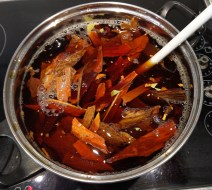 As with the E. sideroxylon experiment, the bark was soaked for a day, then simmered for 45 mins. The water turned from apricot-brown to deep brown-red. I could tell I’d get some colour, even if it weren’t a striking red. After straining, the woollen yarn was simmered for 45 mins and then rinsed in cold water straight away. Why? Why not.
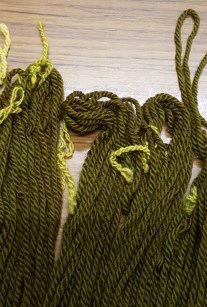
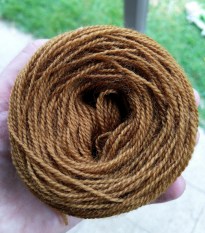 The result was a pleasing medium-darkish honey-brown (a bit brighter than in the pic), and worthy of repetition. I’ll be trying this one on tencel, too. Why so many browns lately? This isn’t a common colour in commercial yarns, and I need a certain shade of tencel to complete a project. Moreover, the experiment per se is fun – what other reason could you possibly need?
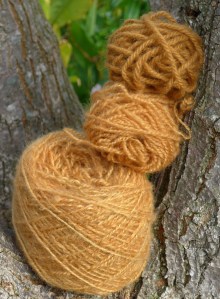
 The dye liquor colours up quickly and is a deep, reddish black. An hour’s simmering, then a straining followed by a sieving (lots of small bits…) and it was ready for the yarn: a skein of 8-ply (bottom, left), followed by one of 2-ply that had been mordanted with alum/CoT as a precaution (bottom, right). As you can see, no mordanting was necessary, but produced a slight greenish tinge on the 2-ply (inside, it looks more golden, so let’s go for old gold/nut-brown butter). The 8-ply – denser and softer – came out a mid-chestnut brown. The colours in the pic are a little richer than in real life.
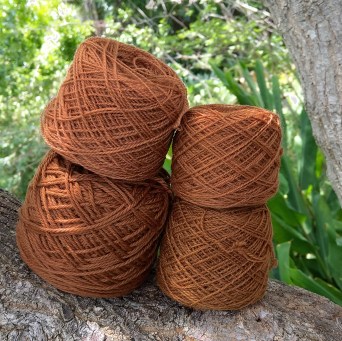 The liquor was still darker than dark, so another two skeins of the 2-ply were dyed individually. The first (top, left) came out a paler brown with a reddish tinge after an immediate wash; the second was left in the liquor overnight, producing a richer colour all round.
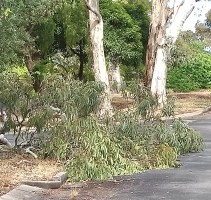 branches due to drought or a sudden uptake of water when the rain comes after a period of dry; this year the weather is so up-and-down that I can’t give the exact reason, which sometimes a gum doesn’t need…) and it’s still at the side of the road, though there’s less of it.
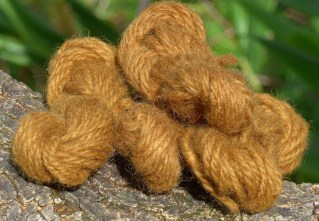
 After driving past it once, I went back with pocket saw, secateurs and large bucket, then went back again for seconds. How much did I manage to harvest? Compare the ‘before’ and ‘after’ pics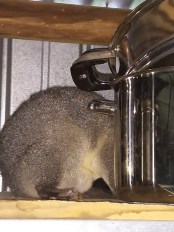

 Dolly’s second outing on the same day was to model a shawl. Before I go any further, I should point out that this is not some weird fetish; the model is named after a real-life character from childhood visits to my grandparents’ in Battersea. No resemblance other than the name.
 see post below), and some of these blended. I had no idea how the colours would go together, and how I would achieve this, so in the end just went for knitting to the pattern until one ball ran out and choosing another, going down the scale from red to brown, dark to light, and finishing with darker and redder again. It worked.
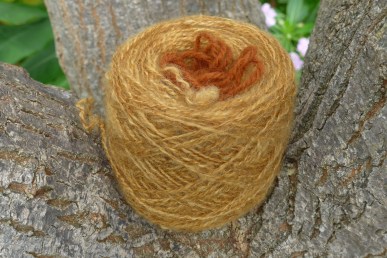 small skein (a tie, really) of commercial yarn thrown in (see centre of ball) – this came out a deep brown which was what I had been aiming for after consulting a couple of sources. The next day I added a full skein of handspun, plus two other ties of the commercial, simmered them for well over an hour and waited for the same brown.
 s much as the commercial and therefore wasn’t as receptive (porous?). It was also thinner, and translucent.
 Barely noticeable, so not one to repeat when contrast is called for.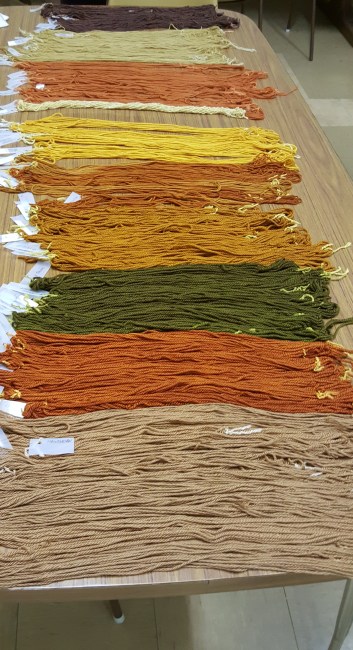

 when we dipped half (or more) of the skein back in the liquor with bicarb added, well, even better.
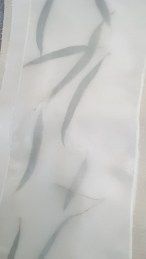 A while ago I came back from a local op shop with a number of silk scarves and hankies, and leaf prints and indigo in mind. Then this weekend I managed to get hold of some Eucalyptus nicholii leaves, thanks to the local parrots who are currently “pruning” all the local trees and scattering the contents within easy reach. Nice.
 placing another scarf on top and wrapping them up in a small bundle. They were placed in the steamer for around two hours, but I can’t be sure of the exact time.
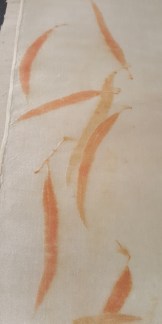 After cooling slightly, the bundle was unwrapped with a pleasing result. The leaf prints appear slightly darker on one scarf, which was opaque, but one the translucent scarf they add to the blowing-in-the-wind effect rather than looking stationary.
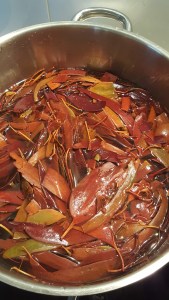 lorry parked on the last remaining patch of undeveloped land had me heading off with secateurs and collecting bag.
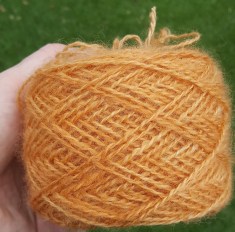 aves were given their own pot to soak in overnight. The next morning, the fresh leaves had started to ferment, and there was a waxy film on the surface and the sides of the pot. Simmering for an hour produced no noticeable colour (just an unpleasant smell), so I turned to the dry leaves. The liquor was already a deep brown before cooking, and after an hour the yarn was added. It had already been in a E. sideroxylon dyepot and had only picked up a smidgen of colour. This time, however, the yarn took on a straw colour.
 E. cinerea is about the only eucalyptus I’ve had success with in the dyepot. Although many sources advise that a mordant isn’t necessary, I wasn’t going to take any chances: 50:50 alum + CoT to 15% wof it was again. The leaves were dry and had been lying at the side of the house for a few months in the hope that some extra sun would improve the colour. They were placed in the pot along with their twigs, normal tap water as opposed to filtered, and simmered for about an hour. The liquid was a pale apricot colour, as opposed to E. sideroxylon which gives a deep, chocolate-red as
 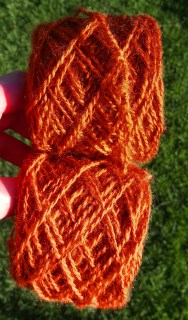 soon as it hits the water.
 Hedgerow weaver