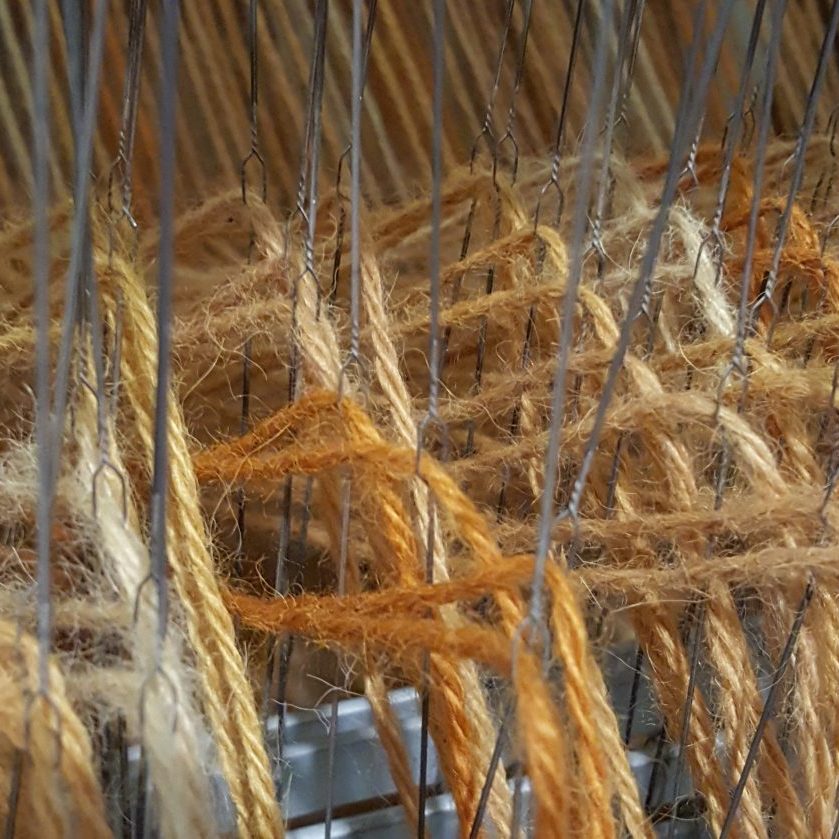
I came across this completely by chance in an Indian grocery (ratan jot रतन जोत in Hindi) a while ago and bought two bags of it, then grabbed two more bags for fellow Guild members. It was only $2.50 a bag, maybe 100g, so too good to miss. That particular shop has stopped selling it, and I’m wondering if it’s since become a prohibited food item: it’s banned for such purposes in the UK.
Anyway, back to the alkanet… I steeped the root in alcohol for five days – a whole bottle of meths, to be precise. This didn’t make it a very cheap experiment, but I had fun.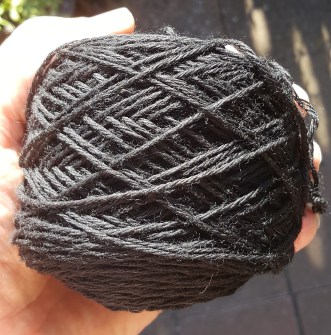
Alum-mordanted yarn was then heated in the strained liquor plus enough water to make a dye bath for an hour, then left overnight to cool. The resulting yarn was blacker than black – a blackboard after it’s been washed at the end of the year, hands after they been sorting through the coal scuttle, fingers after they’ve finished blackening the grate (someone else will have to verify the last two – London was already a smokeless zone by the time I was born). The photo was taken in the evening sun on a 42oC day, so doesn’t really reflect the blackness of the yarn.
I have yet to test for lightfastness, which I understand isn’t high, but will start with a pair of socks if the two balls will stretch to a pair of size 12’s.
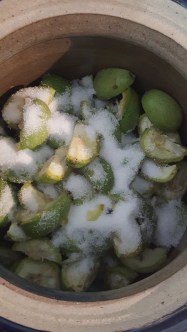 After coming across some walnut trees a few years ago, I decided to try pickling the unripe fruits, then discovered a recipe for nocino. The fruits are cut up, then steeped in vodka, sugar, lemon zest and spices for a month. It only takes a few days for the mixture to start turning black, which got me thinking; if the walnuts can stain anything in sight (hands, chopping boards, counter-tops, etc), maybe they can also dye yarn?
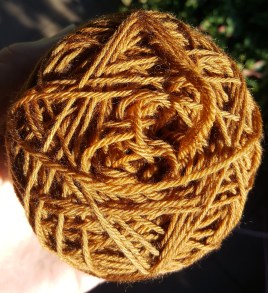 e smell was like Christmas cake from the start of the process to the very end, and one year later the yarn still smells yummy. I might try making something with it if I can bear to stop smelling it.
 I originally came across this plant in Rodale’s Illustrated Encyclopedia of Herbs many moons ago, and after the internet took off, started searching for it high and low. I was very kindly sent a small cutting by an interstate nursery with an order, but one day of typical Adelaide summer weather put pay to that. Then a couple of years ago, I was able to order a couple of packets of seeds from a US nursery. This was after waiting for
 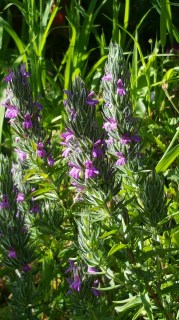 , but it produced enough seeds for me to grow a second run this year (which was good as I’d misplaced the packets). This time I thought more about the conditions it would need: a plant from mountains in the Mediterranean and Middle East… The seeds were sown on top of potting compost with a thin covering of vermiculite.
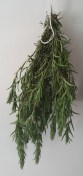 So, what’s it used for? There’s zatar (funny, that) – the spicy mixture for dipping bread (after a dip in olive oil), and no doubt any other recipe that calls for some herbal zip. I’ve asked a number of acquaintances from the Middle East what they would use it for, but they tell me that za’atar is thyme, or Syrian oregano. It could be any one of a number of plants, including Satureja. I guess it depends where you’re from and what herb is locally available to give that spicy-herby flavour.
 pun. Perhaps it was waiting the arrival of the penny tahkli? I wanted to get some slubbiness to the yarn, so left lumps and bumps in it at regular intervals. The trouble is, more practice = less character to the yarn. During a recent alpaca spinning workshop at the Guild, I quoted the English comedian Les Dawson and his signature act of playing the piano with carefully placed “wrong” notes. He explained during an interview that you had to be good at playing the piano before you could be intentionally bad. In spinning terms, I guess that explains the difference between a beginner’s yarn and an art yarn. Nevertheless, yours truly shall continue to practise being intentionally bad.
 Last time I was in Sussex, two years ago, the Ditchling Museum was only just getting ready for opening. I’d been through the village so many times in the car before, while and after I lived in the county, and spent the brief passages through gazing out of the car window at the beautiful, old, timber-framed buildings. So, time to actually go there and wander round, looking at the buildings up close and exploring the few lanes behind the main crossroads and, of course, the pond.
 nd dyeing. It was a short train ride to Hassocks, then a half-hour walk along a country lane full of brambles, hemp agrimony, chamomile, wild carrots and other dye plants, not to mention the drying buddleia heads in the gardens and alongside the train tracks. The museum itself is small enough that you don’t get tired walking around, but with just the right amount of exhibits that you feel you’ve spent a worthwhile and very educational trip. Yes, I’d go there again!
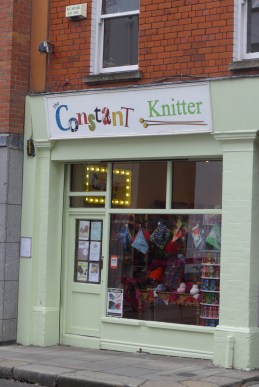 I took advantage of cheap airfares to go to Dublin for a few days. It’s always been an ambition of mine, also to walk into a pub an order a pint of Guinness in Gaelic. I managed to do a lot of sightseeing – not all that I’d planned – but that leaves plenty for the next visit – and Dublin is a very walkable city. It was as I was walking to St. Patrick’s Cathedral that I passed, by pure chance,
 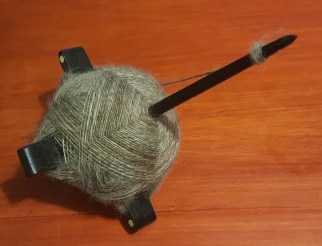 of my recent holiday in England were all fibre-related. I bought small Turkish spindle from
 stiffer both before and after laundering, the wibbly-wobbly effect is the same and the finished article has all the drape and comfort expected of tencel.
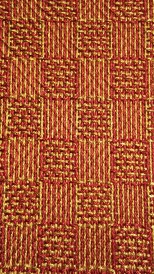 Having set the loom up for boxes some time ago, I wondered what I could weave using the same tie-up. Lazy? Perhaps, but it lead to something worthwhile…
 more suited to a thicker yarn where the design would be more evident. Then one stood out form the rest… the moving boxes.
 the loom and allowing the weaving to relax, the curves became irregular. Laundering at 40C in the front loader left the fabric soft and silky, and the boxes are permanently “moving”.
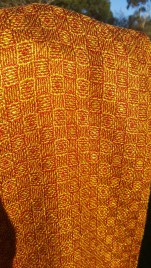 to be comfortable.
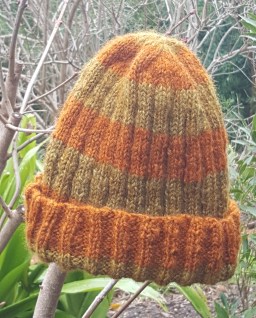 Someone pointed out that this could very well be the colours of a hitherto-unknown footie team. Better not wear it down the Port, then. Or to a quidditch match.
 Hedgerow weaver