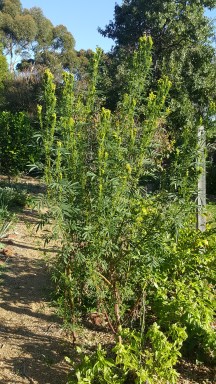
 Tagetes minuta, aka Peruvian mint, huacatay, stinking Roger… and a noxious weed in many parts of the world. It does however have some interesting uses: seasoning, herbal tea, medicine, garden stake and dye.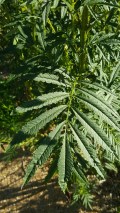
I obtained a plant without knowing anything about it last year at an open garden. It grew to the prescribed metre high, flowered briefly, then disappeared in winter. This year several offspring appeared and grew exceptionally well – to over 6’2″ (they’re taller than me, and that’s when I stopped measuring). Fantastic! But what about the dye?
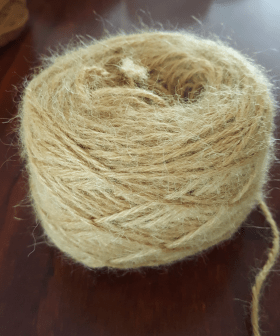
I had a couple of balls of wool from an op shop. They looked like handspun that had been previously used, then unravelled. The strands stuck to each other like a cross between a limpet and velcro and have several knots after washing, drying and re-skeining.
Left to right, 1) undyed, 2)u nmordanted & dyed with 400% wof dried tops, 3 + 4) 50:50 alum-CoT to 15% wof, dyed with 200% fresh tops and 200% dried tops respectively. Once cool, they were washed with soap nuts; there was no noticeable colour loss. You can see that the yarn used to tie the skeins took on more colour.
The next skein was from a Finn x Romney x Corriedale fleece. I’ve always had trouble with this one, even with commercial dyes. So I added a few more fresh tops to the dyepot, then a few more. What the hell; they’re going to seed anyway.

Madre de oveja! I’ve yet to test for light-fastness, but this colour is intense, no other word for it. I noticed in this skein and the test ones above that the dyeing tends to be patchy, and think this may be due to the tip end of each lock, but can’t say for certain. Not that it detracts from the overall wow-factor. Will definitely be using the other three or four plants drying in the shed.
 but there was Alice, trying to make her way through the first door after drinking the potion that made her smaller. The floor had black and white tiles, chequer-board fashion, and because the floor was sloping, perspective made the tiles smaller in size the closer to the door they became.
 r about an hour. It took considerably longer than this to strain the liquid through double muslin, but has probably saved even more time that would have been spent trying to get the fine particles out of the yarn. This is destined to be the weft to go with the dahlia-dyed yarn.
 I only had a few small dahlia plants in the garden, but a local enthusiast came to the rescue with what must have been about five kilos of freshly lopped flowers – plenty to experiment with. I don’t know what percentage of the weight of a fresh flower is water, but as they dried, so it became clear that 5kg wasn’t going to go as far as first thought. However, the results were pretty amazing.
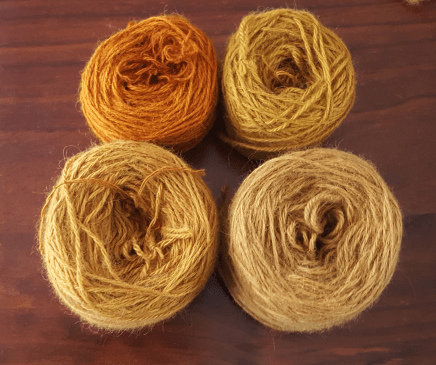 ite alpaca, mordanted with alum at 10% wof. They were simmered for another hour, then one skein was removed. A generous spoonful of bicarb was added to the pot, turning the remaining skein copper. I wasn’t able to repeat the effect with the remaining dyepots, but got very acceptable results nonetheless. The photo shows them paler than real life.
 Hedgerow weaver