After spending some weeks deciding on what exactly we were going to dye with, and then worrying on more than one occasion that the dyes weren’t going to p
erform, last Saturday’s workshop was full of pleasant surprises…
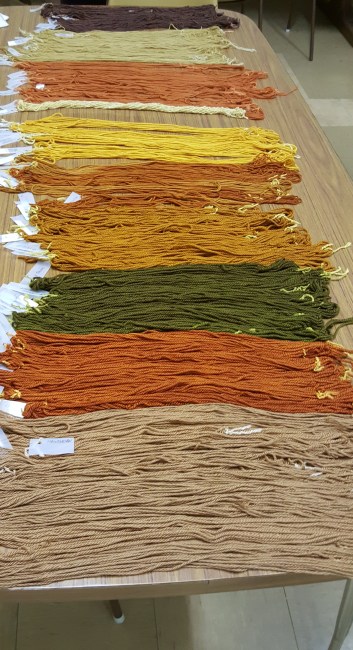
There were seven participants, all friendly and enthusiastic, and all with interesting tales, information and tips to add to the proceedings. The dyes used were (from bottom to top): hawthorn berries, brown onion skins, red onion skins, Tagetes minuta, dahlia flowers, Tagetes lemonii (dried flowers/heads), Eucalyptus cinerea, E. incognita (yep!) and betel nuts.
I didn’t have time to follow Jenny Dean’s recipe (in Wild Colour) for the haws, so boiled up some leaves and twigs for about 40 minutes to get as much tannin in to the dyepot, then added about a kilo of berries and simmered for three-quarters of an hour, then left overnight. This mixture was strained and reheated for the dyeing experiment. They turned the woolen yarn a shade of light brown that I’d never had before, so that’s one for future ref.

The onion skins were amazing! (right to left: brown onions, red onions, Tagetes lemonii). Even though we used a scant 50% wof, the brown ones dyed a deep copper, while the red ones (close-up below) came out dark, khaki green; the unmordanted ties were lime green, and both without trying. Could it have been the copper pipes at the Guild?
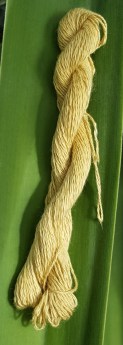
A smaller quantity of dahlia heads than I would have liked gave such a deep colour, and 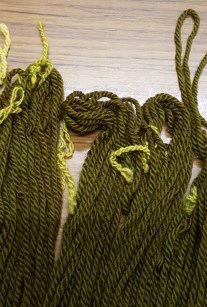 when we dipped half (or more) of the skein back in the liquor with bicarb added, well, even better.
I was concerned that as the tagetes flowers were dry, they’d give muted shades of old gold. Lemonmii gave such a deep sunshine gold that at first I thought it was the brown onions, and the minuta heads could have been fresh – the brightness and intensity of the resulting colour is still a source of amazement.
E. cinerea performed to its usual standard, while the other (maybe a type of peppermint gum?) gave a very pale yellow. Still a good shade to have in the line-up.
The betel nuts? These gave a deeper brown than I’ve ever managed before. None of the pinkish hue, mind. They were, as last time, soaked in water and bicarb for a couple of days.
All in all a successful run of experiments and a great bunch of people to work with!
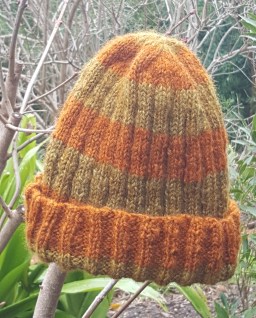 Someone pointed out that this could very well be the colours of a hitherto-unknown footie team. Better not wear it down the Port, then. Or to a quidditch match.
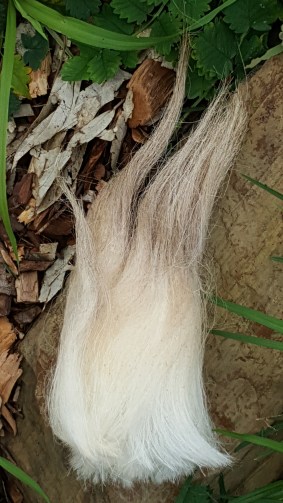
 ng didn’t work, as at the bottom end there are a lot of shorter, finer fibres. With combing, I was able to remove these and set them aside to see what they spin up like. I’ll probably scour them and then put them through the wool combs.
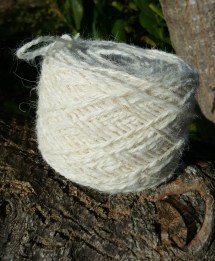 asy to manage, and quick to spin and ply. The resulting yarn is quite pleasing for a first attempt – definitely too coarse for much other than a carpet, but still with a degree of softness. After scouring the skein, it came out whiter than white. I look forward to seeing how well it takes dye.
 less than 10km from home.
 r and damp at the moment, so I wanted to avoid the harvest going mouldy.
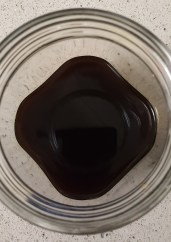
 e and with a bit of stirring….. treacle.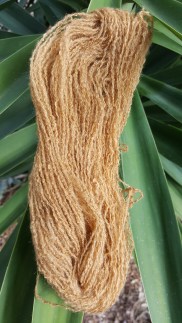
 Hedgerow weaver