Des noix marinées, eingelegte Walnüsse, nueces en escabeche, gallchnónna picilte
I first heard of these in an episode of Dear Ladies where they were dumped by one of the ladies on the dining table in front of the other with comic contempt. They seemed to be in one of those jars that you find every now and then over the years at the back of the cupboard, but never open or use. In Greece once we were served ice-cream (it was colourless, practically tasteless and had slathers of ice in it – maybe a packet mix?) with a sauce that tasted like something out of one of those jars. Most unusual for a country where fresh food is the norm and nothing is short of tasty. Anyway, the walnuts… I imagined walnuts as we usually eat them, shelled and halved, in a jar of vinegar.
I didn’t make the usual half-gallon of nocello this summer, but decided to pickle the green fruits instead using this recipe. I’d liken the process to pickling olives, but darker and stainier.  First came trimming (I’d had them in the fridge whilst deciding what to do; some of the ends were a bit brown), then pricking all over with a needle. The second picture, right, shows them after bathing in brine for a day. A friend asked if the plate was made of walnut, too. Good point, and I swear th
 e pattern was purely by chance. It was however ordinary, white china.
Then came the first change of brine. By this time, I’d given up on the idea of the bowl reverting to its original white colour at the end of the process. C’est la vie… The fruits themselves hadn’t changed so much, and it was back in for another bath after changing the brine. I’ll admit to leaving them in the second bath for a little longer than recommended, but it seems to have worked.
Finally they were fished out and strained, then left in the sun for a couple of days. With temperatures in the high 30’s and low 40′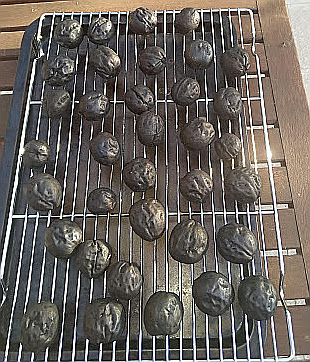 s I wondered if they might dry beyond redemption. Instead they turned a fantastic metallic shade, like Christmas beetles. And wrinkled. I still made sure they were handled with tongs (dyeing walnuts and spinning silk and wool means you need to pay special attention to all that potential dye, and your fingers).
And th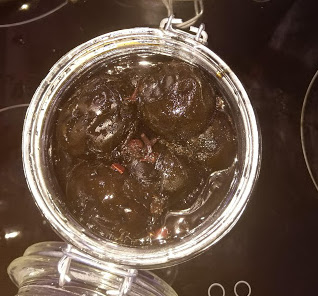 e result? They were simmered in the pickling mixture, then everything placed in a couple of jars with a glass milk watcher on top as a weight, and left for a couple
  of months. Naturally one had to purchase some Stilton to go with them. The first one out was a little soft; it broke up but was still worth the effort – a sort of pickled pate. The second kept its shape more when cut. And the taste? Definitely worth the Stilton, and worth eating all of them by the time the next lot are ready. If they last that long. The picture really doesn’t do them justice.
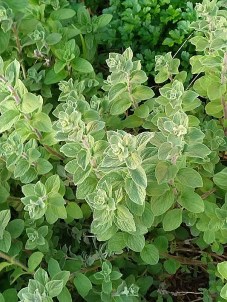 I grew some seeds of this a few years ago, about the same time that I was looking for za’atar. Some seed catalogues list them as one in the same, but with some research I found that za’atar can be Thymbra spicata, Origanum syriacum, Thymus vulgaris, Micromeria spp. or Hyssopus officinalis – depending on where you live and what grows locally.
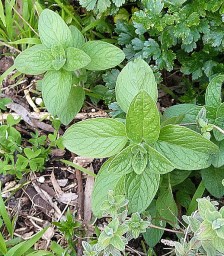 strongly, but also has a couple of stems – on the one plant – with larger than usual leaves, so big that I had to run my finger down the stems to their origin to check they weren’t mint.
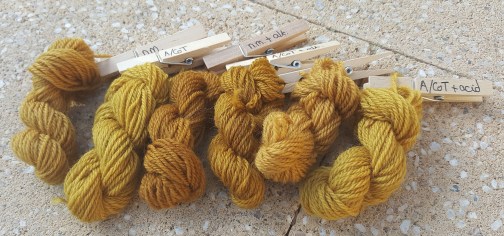 modifier (skeins 3 & 4) darkended the colours, whilst the acid modifier (5 & 6) lightened them. Skeins 1, 3 & 5 demonstrate that no mordant is required. Each shade obtained is, however, worthy in its own right and in real life all are far more vivid.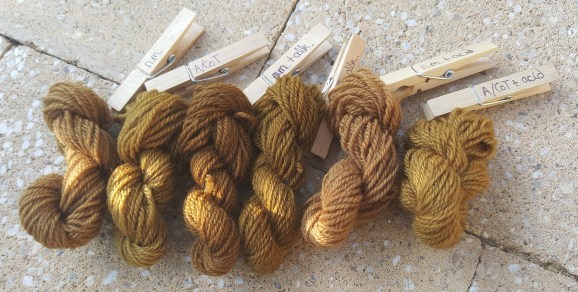
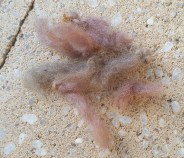 t.
t.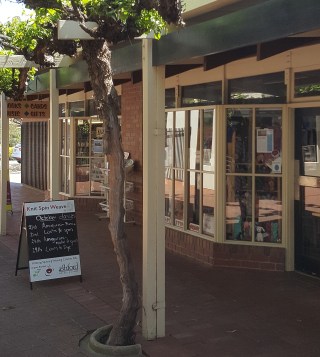 I’d “chatted” to Tracy a few times by email about workshops, so it was a pleasure to finally meet in person. Her shop,
  other Victorian/Edwardian children’s story that didn’t need much apart from a few eccentric characters and the English countryside to hold your attention. The spooky parts (the carriage driver and the landslide) seemed much spookier on the LP; I recall someone lending it to us when I was ill and advising Mum not to let me listen to it alone. No fear!
 Last time I was in Sussex, two years ago, the Ditchling Museum was only just getting ready for opening. I’d been through the village so many times in the car before, while and after I lived in the county, and spent the brief passages through gazing out of the car window at the beautiful, old, timber-framed buildings. So, time to actually go there and wander round, looking at the buildings up close and exploring the few lanes behind the main crossroads and, of course, the pond.
 nd dyeing. It was a short train ride to Hassocks, then a half-hour walk along a country lane full of brambles, hemp agrimony, chamomile, wild carrots and other dye plants, not to mention the drying buddleia heads in the gardens and alongside the train tracks. The museum itself is small enough that you don’t get tired walking around, but with just the right amount of exhibits that you feel you’ve spent a worthwhile and very educational trip. Yes, I’d go there again!
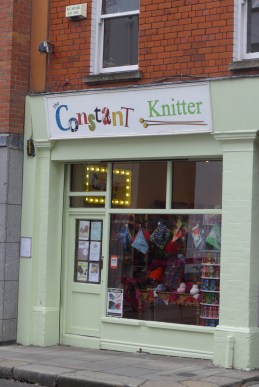 I took advantage of cheap airfares to go to Dublin for a few days. It’s always been an ambition of mine, also to walk into a pub an order a pint of Guinness in Gaelic. I managed to do a lot of sightseeing – not all that I’d planned – but that leaves plenty for the next visit – and Dublin is a very walkable city. It was as I was walking to St. Patrick’s Cathedral that I passed, by pure chance,
  Hedgerow weaver