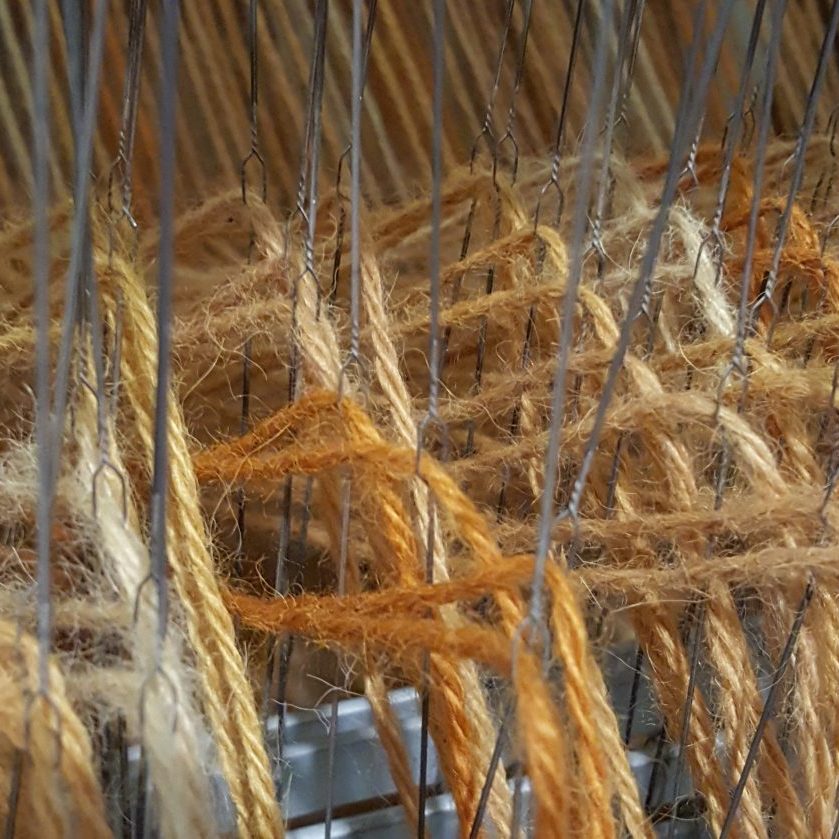
(English version below)
Habe ich das Buch vor einer Woche auf Google Books gefunden. Es wurde in Fraktur gedruckt. Der Autor hieß Joseph Mollenhauer: praktisch gelerneter Färber zu Fuld. Und das Titel: Praktischer und sehr anwendbarer Waid und Schoenfaerber zum Gebrauch für Wertmesiter und Liebhaber.
Die Vorrede beginnt so: Da ich wegen politischer Verfassung des Staates meine praktische Kentniße nicht weiter benutzen kann noch darf; so bin von vielen Freunden aufgefordert worden, diese meine Färbkenntniße gemeinnützig zu machen.
Ich habe noch nichts um die politische Verfassung zu dieser Zeit in Hesse herasugefunden. Trotzdem wird das Buch mir immer mehr interessant. Kann es das Original sein, oder eine Kopie?
Vor der Vorrede wird geschrieben – und es scheint in zwei Shriftarten zusammen – Dieses färbbuch gefördert (?) mir Johann Henrich Marx… November 1806. Die Vorrede wurde aber am 30 April 1801 geschrieben. Vielleicht wurde denn diese Inschrift vom Verwandten geschrieben? So viele Fragen, die ohne Zeitmaschine nicht werden beantwortet können..
A little more uncovered…
I was able to find a printed copy of the work on Google Books, written in Fraktur – a lot easier to understand! It was written in 1801 by Joseph Mollenhauer: experienced dyer at Fuld, and titled Practical woad and beautiful colours for the use of professionals and enthusiasts. I’m still deciding on the best translation, so don’t quote me on that for the time being.
So, was this the original, or a handwritten copy? Just before the introduction there is a page that states This book was …. to me by Johann Henrich Marx… November 1806. This inscription seems to be written in two different scripts, and with the word for “this” – dieses – looking more like vinfub, you can understand the difficulty in trying to decipher it. What is clear is that the introduction was written on 30th April, 1801.
The author begins his introduction, Because I can’t practise my craft any longer due to the State constitution, many friends have asked me to pass on my dyeing knowledge. I haven’t yet been able to find out what the constitutional thingamajig was, but have been wondering why my BA couldn’t have included being thrown such a work and being told to go and research it…
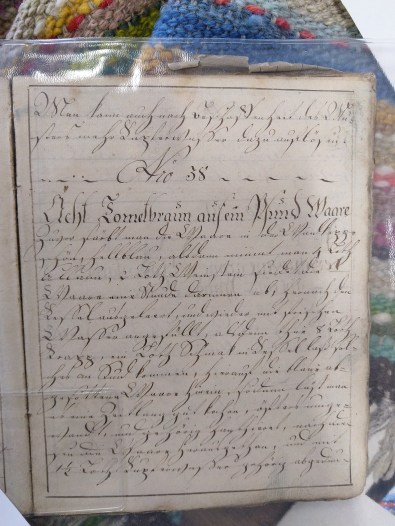 Am Anfang des Buches steht das Alphabet in normaler Handschrift. Auf der
 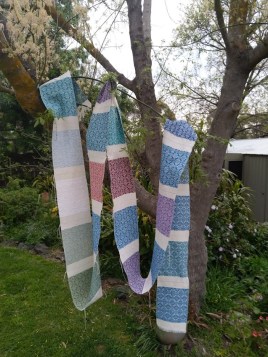 The actual project was an excellent idea to use up a donated stash of cottons and honour the memory of a former Guild member. Each participant would weave 20 (or was it 21?) squares in overshot, one for themself, one for everyone else and one for the Guild. Each would choose their own pattern in 4-shaft overshot and their own colours. You could either accept squares woven in other people’s colours, or wind off the weft for everyone to weave in your colour. The squares would then be exchanged at a meeting a few months down the track and each participant would sew their squares into a quilt. That’s what I hadn’t been aware of to start with. A quilt? Sew? Squares and straight lines? Too late to back out now…
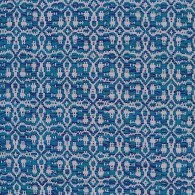 a long fight with the warp: three stands of very fine cotton that was as much fun as brushing the tangled hair of a squirming four-year-old. I’d never woven overshot either, but was no stranger to weaving with two shuttles, and at the rate of at least one square per evening, they were all finished in time. I chose the particular draft as it reminded me of nasturtium leaves, although as with most patterns, stare at it long enough and you start to see other things: keys, crosses, diamonds…
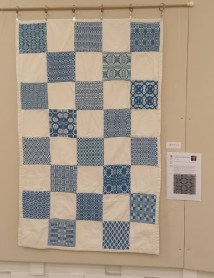 Squares separated and exchanged, it was time to start sewing. Or thinking about it, buying batting, then more thinking… That process alone, together with buying fabric, thread and a walking foot for the sewing machine took another three months, then submitting for a group exhibition. I had asked that a sign be put next to mine declaring that I was a first-timer and had done woodwork and metalwork at school instead of sewing… and I wasn’t joking. At least it was displayed back-to-the-wall so that the bits of dodgy sewing (when the machine starts making noises and the fabric doesn’t move forward) weren’t visible. The edges are actually straight, contrary to how it was hanging at the time. Honest. First attempt, what can I say…
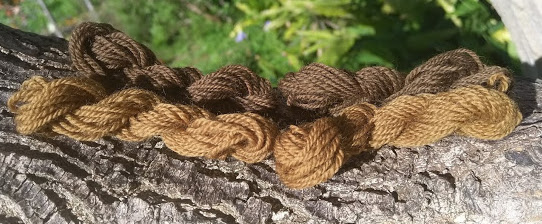
 The results were not sufficiently different from dyeing without pre-treatment to warrant such a lengthy procedure, although I may well try fermenting without adding bicarb in future.
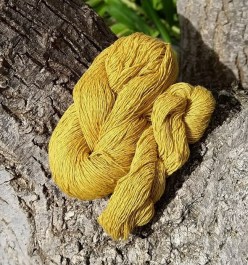 The yarn was left to cool in the liquor overnight, then rinsed well. A smaller sample was cut off and washed in cheap washing-up liquid. Although some colour came out in the water, there is no difference in the two samples to the naked eye. An unmordanted sample of cotton was added to the original dyebath, but came out the palest yellow (the sample has since vanished…).
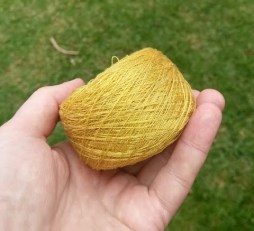 put off a while ago by weaving with hand-dyed (fibre reactive) 10/2 that broke a few times. I intend to use it in the future, but in the meantime it’ll be used for dye experiments while I save the 8/2 for weaving for weaving’s sake. The shade obtained was lighter than the cotton; I thought that it may have come out deeper, considering how well tencel takes up fibre reactive dyes, then was reminded that a another experiment gave cotton and tencel an equal footing in this respect.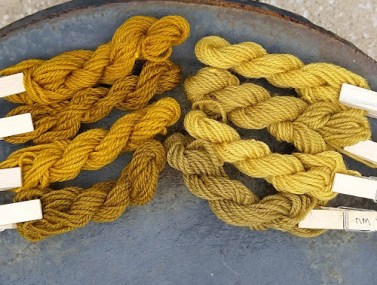

 First came trimming (I’d had them in the fridge whilst deciding what to do; some of the ends were a bit brown), then pricking all over with a needle. The second picture, right, shows them after bathing in brine for a day. A friend asked if the plate was made of walnut, too. Good point, and I swear th
 e pattern was purely by chance. It was however ordinary, white china.
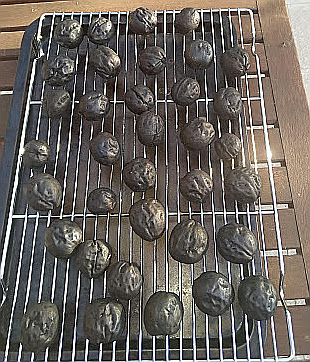 s I wondered if they might dry beyond redemption. Instead they turned a fantastic metallic shade, like Christmas beetles. And wrinkled. I still made sure they were handled with tongs (dyeing walnuts and spinning silk and wool means you need to pay special attention to all that potential dye, and your fingers).
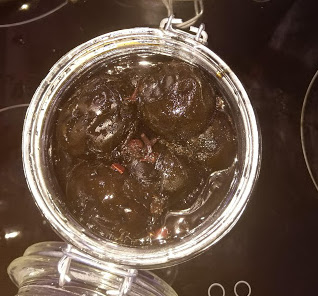 e result? They were simmered in the pickling mixture, then everything placed in a couple of jars with a glass milk watcher on top as a weight, and left for a couple
  of months. Naturally one had to purchase some Stilton to go with them. The first one out was a little soft; it broke up but was still worth the effort – a sort of pickled pate. The second kept its shape more when cut. And the taste? Definitely worth the Stilton, and worth eating all of them by the time the next lot are ready. If they last that long. The picture really doesn’t do them justice.

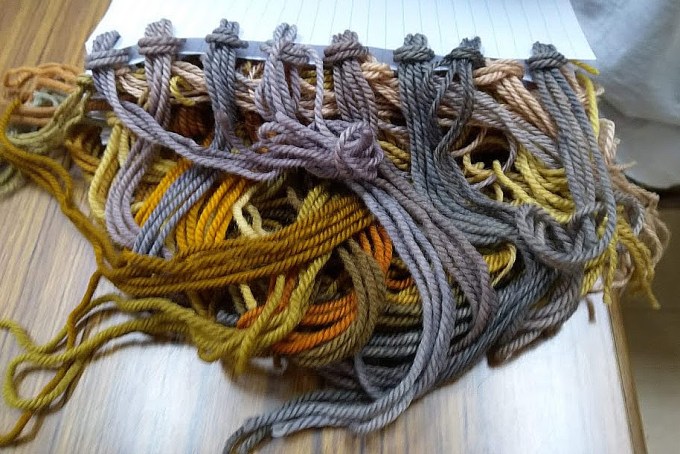 As with E. sideroxylon at the last workshop, the nicholii decided it preferred to stay brown rather than red, but the alkanet decided to show a little more purple. The biggest surprise was the Houttynia: rather than giving the golden yellows of a previous experiment, it gave the palest green. With an iron modifier, this gave a rather interesting shade of grey-green. One to aim for again.
 Hedgerow weaver