Common reed, roseau commun, Schilfohre, carrizo, giolcach
I’d read about dyers obtaining a green colour on wool from the common reed, so was naturally eager to give it a try. The past two years I’ve missed a very short flowering season due to high temperatures, but this year managed to harvest some in its second flowering (the weather has been up and down like a yoyo).
On the way to a spot where it grows abundantly (and will need thinning very soon if it’s not to take over the shallows of the artificial lake), I started thinking about greens… Greens from purple… The local variety don’t have purple flowers, maybe a slight tinge, but nothing like I once saw in Engl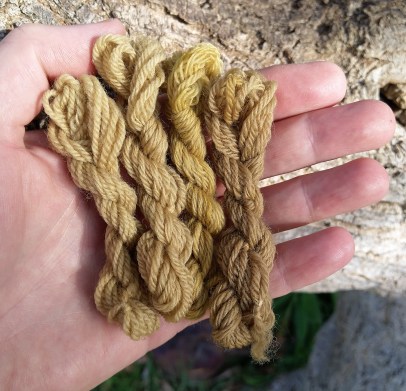 and. As a child with a thirst for natural history (is it still called that?) and a small but highly informative collection of nature books, I stood gaping at this tall grass with purple flowers – all very exotic. If memory serves correctly, I took a couple of flowering heads home, but the purple didn’t last. I can’t remember where it was, but have a lot of fond and grateful memories of day trips in to the countryside where there was always a new discovery.
So, back to Australia… some sources say the plant is native, others an introduced species… but it still lacks the purple. Well, at least I’d get a yellow or beige out of it, I was sure.
On the far left, the unmordanted yarn is very close in colour to its mordanted neighbour. The third from the left is mordanted + bicarb modifier – slightly more yellow in real life as was to be expected. On the far right is mordanted + Fe modifier. A useful experiment? Yes, and colours to add to a palette.
 eoclaip
 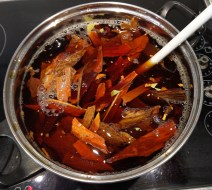 As with the E. sideroxylon experiment, the bark was soaked for a day, then simmered for 45 mins. The water turned from apricot-brown to deep brown-red. I could tell I’d get some colour, even if it weren’t a striking red. After straining, the woollen yarn was simmered for 45 mins and then rinsed in cold water straight away. Why? Why not.
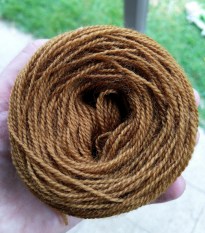 The result was a pleasing medium-darkish honey-brown (a bit brighter than in the pic), and worthy of repetition. I’ll be trying this one on tencel, too. Why so many browns lately? This isn’t a common colour in commercial yarns, and I need a certain shade of tencel to complete a project. Moreover, the experiment per se is fun – what other reason could you possibly need?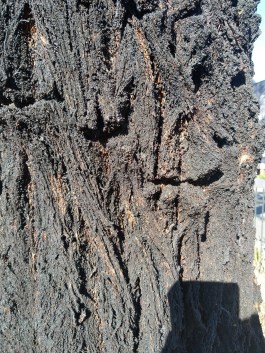
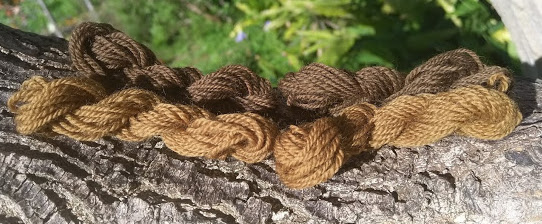
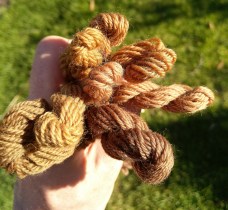
 The dye liquor colours up quickly and is a deep, reddish black. An hour’s simmering, then a straining followed by a sieving (lots of small bits…) and it was ready for the yarn: a skein of 8-ply (bottom, left), followed by one of 2-ply that had been mordanted with alum/CoT as a precaution (bottom, right). As you can see, no mordanting was necessary, but produced a slight greenish tinge on the 2-ply (inside, it looks more golden, so let’s go for old gold/nut-brown butter). The 8-ply – denser and softer – came out a mid-chestnut brown. The colours in the pic are a little richer than in real life.
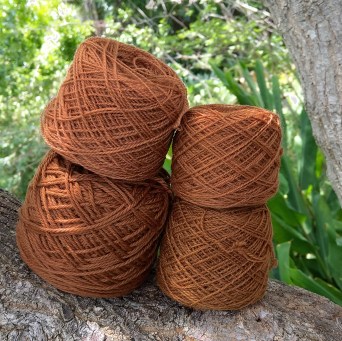 The liquor was still darker than dark, so another two skeins of the 2-ply were dyed individually. The first (top, left) came out a paler brown with a reddish tinge after an immediate wash; the second was left in the liquor overnight, producing a richer colour all round.
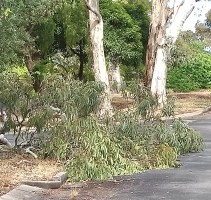 branches due to drought or a sudden uptake of water when the rain comes after a period of dry; this year the weather is so up-and-down that I can’t give the exact reason, which sometimes a gum doesn’t need…) and it’s still at the side of the road, though there’s less of it.
 After driving past it once, I went back with pocket saw, secateurs and large bucket, then went back again for seconds. How much did I manage to harvest? Compare the ‘before’ and ‘after’ pics

 The results were not sufficiently different from dyeing without pre-treatment to warrant such a lengthy procedure, although I may well try fermenting without adding bicarb in future.

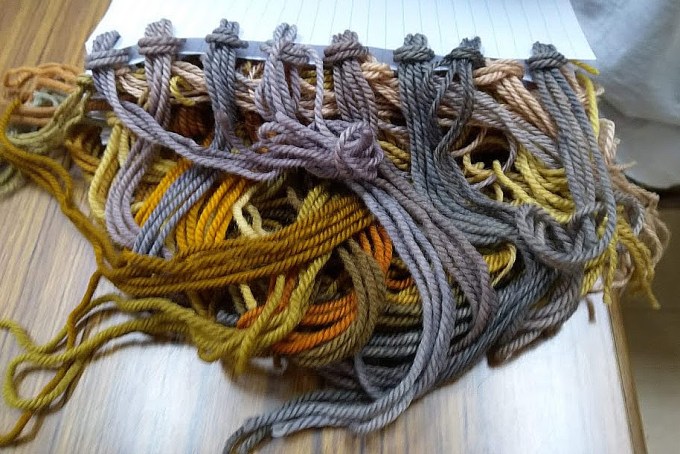 As with E. sideroxylon at the last workshop, the nicholii decided it preferred to stay brown rather than red, but the alkanet decided to show a little more purple. The biggest surprise was the Houttynia: rather than giving the golden yellows of a previous experiment, it gave the palest green. With an iron modifier, this gave a rather interesting shade of grey-green. One to aim for again.
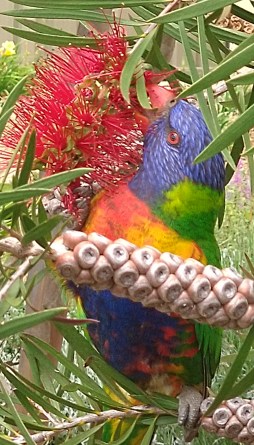 Callistemon spp., Rince-bouteille,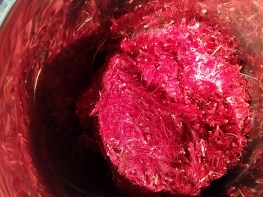
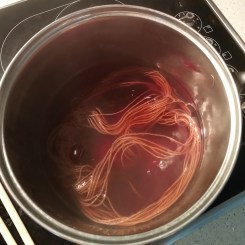 m/CoT mordant gave yellower shades, the alkaline modfier deepended these, the acid modifier didn’t make much difference, although I think (or perhaps am imagining) a slightly redder shade, whilst the iron modifier clearly deepened the shades as expected without “blackening”. There’s also none of the potentially resulting harshness.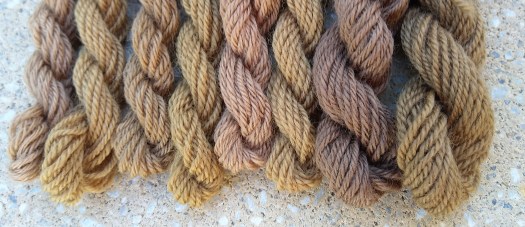
 Hedgerow weaver