Des couleurs reproduites, nachgebildete Farben, colores reproducidos, dathanna macasamhla
Talking of Otavalo market (see the previous post), the colours I remember most are browns and reds – earthy colours – as well as white, black, grey and other browns, presumably natural (undyed) colours apart from the reds.
Many a conversation with a Chilean friend on all things cultural led to the idea that I might be able to reproduce some of those colours in a scarf-cum-birthday present for her. At that time the only woollen yarn I was weaving with (I was still a beginner) was a very fine blue-grey, plied double at 24epi. Why blue-grey? I’d bought some old 1kg cones of Wangaratta Mills yarn from someone who’d be given it but was unable to use it for handknitting. It overdyed well in most colours, so why not…
 The photo shows just how well it turned out using two shades of brown and a red at half strength (all Landscape dyes). Several small samples of that experiment remain, but very little of the blue-grey yarn. The solution? Grey handspun?
 The day began with a display table (photo used with permission) that was a true feast for the eyes: braids and straps in all colours and designs and even some balls of yarn in traditional colours. This reminded me of Nilda Callañaupa Alvarez on the Interweave dvd Andean Spinning talking about keeping balls of yarn until they were “hard”. Laverne showed us a warp set up using freshly-spun yarn; the threads were all spiralled around each other and didn’t want to sit straight. The “aged” yarn on the other hand was “hard” and as straight as can be.
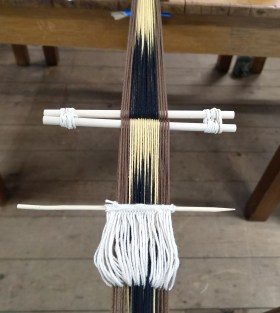 to take and finish at home as well as an introduction to various designs and techniques, and a thirst to practise everything and try out all the fascinating designs in Laverne’s books – we were able to purchase a couple of these as well as a dvd for the Guild library. Needless to say, there’s already a waiting list!
 Hedgerow weaver