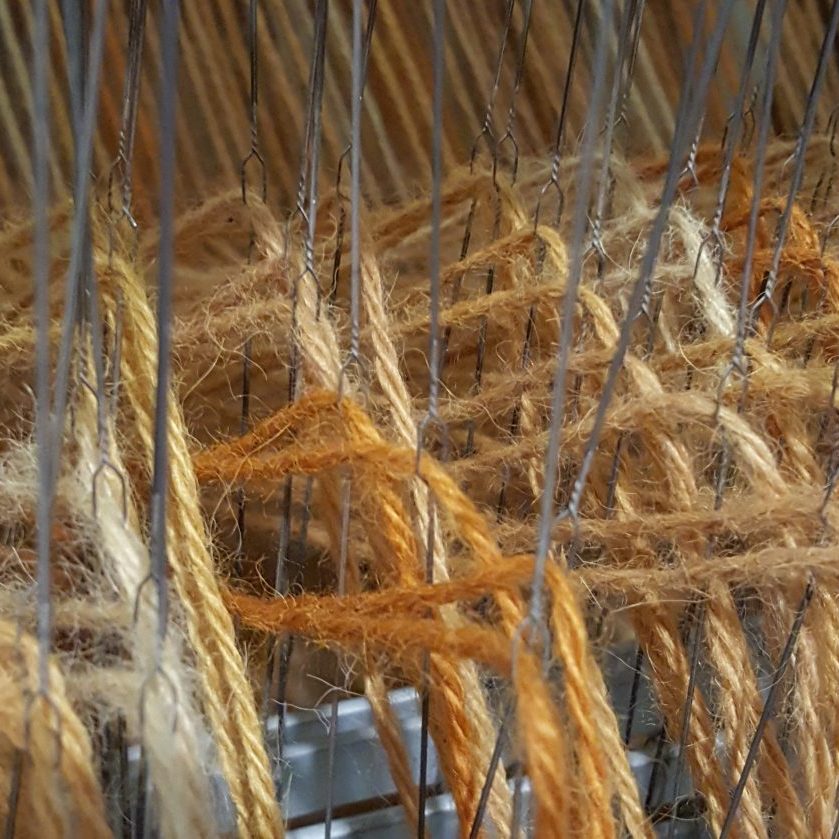
Rubia tinctorum & Rubia cordifolia, Garance de teinturiers et garance ?, indische Krapp u.echte Färberröte , rubia ? y rubia rota, dhá mhadar
Now I really need help with the other languages! Anyone?
I decided to try both “regular” madder and also R. cordifolia (as the latter’s cheaper). I purchased some powdered samples of both varieties and tried them on commercial yarn, mordanted with 10% alum and also with some calcium carbonate added to turn the dyebath alkaline. I couldn’t be sure of this, as the pH paper didn’t change colour, but I added more than the 6g per 100g dyestuff to make sure.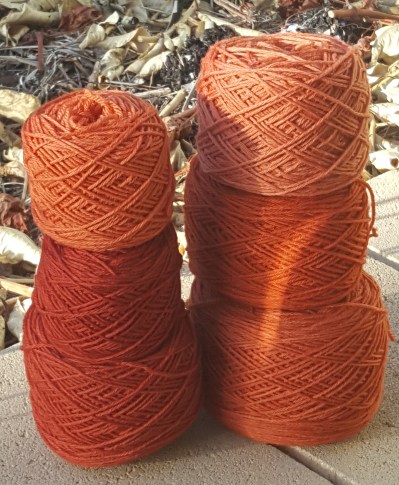
The R. tinctorum is on the left and the cordifolia on the right. From bottom to top it goes thusly: 50% wof, 100% wof, exhaust bath. The cordifolia at full strength gave what I’d call “Indian red” after seeing this tone on so many throws and other items from the sub-continent; the colours in real life are a bit deeper. The top ball was thrown into two exhaust baths, as the dusky pink wasn’t so much to my liking.
With the tinctorum, the full strength gave me what I’d expected, or near enough.
All skeins needed a fair number of rinses to get the particles out of them (it went on the garden); their individual shade was probably twice as dark when coming out of the dyebath, due to the particles sticking to the fibre, but the rinse water was only coloured by the waste particles and no waste/unattached dye.
So, will I use madder again? Not unless I buy a larger quantity from overseas to make it economically viable. When hanging the skeins to dry, the following came to mind: “Avocado skins… avocado pits… Eucalyptus sideroxylon… Eucalyptus cineria…” However, a worthwhile experiment with usable results.
 I’d made a couple of rag rugs some years ago and was amazed at i.) how much warp they required and ii.) how quickly they wove up. The first has become a foot mat under the loom pedals, whilst the second is stretched out in glorious tri-colour in the back room. This time the task was to get through the pile of old jeans and t-shirts that had grown to the right size for harvesting.
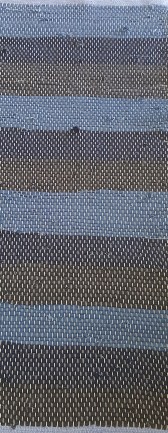 One used 3 pairs of adult male jeans in large, the other 3 1/2 pairs (different sizes). The weft was cut into 1″ strips (more or less), and the binding was approximately half the width, cut from a linen shirt. Actually I have to admit that one of the large pairs was XXL. I’d run out of jeans and saw that they were only $7 new in one outlet, so naturally went for the biggest size I could get. Probably cheaper than an op shop, too.
 All the rugs are actually straighter than they appear in the photos (honest!), and after Mr Knisely’s comment on the DVD (you don’t need both DVD and book as they are in total accord) about never getting perfect edges because they’re rag rugs, I felt better.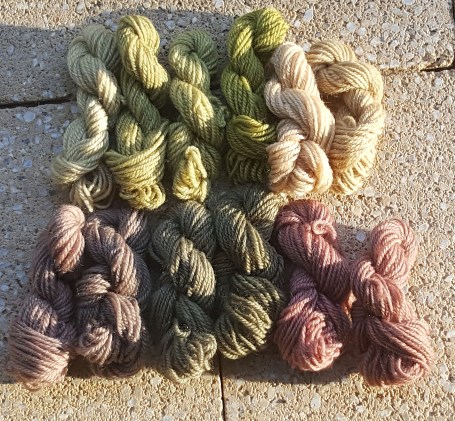
 Hedgerow weaver